Your Last Post Got Four Likes. Here’s Why That’s Not a Luck Problem
Your Last Post Got Four Likes. Here's Why That's Not a Luck Problem.
Your last post was probably fine.
Good photo. Correct information. Posted at the right time. Maybe you even added hashtags.
And it got four likes, two of which were from people in the office. The others were from your family.
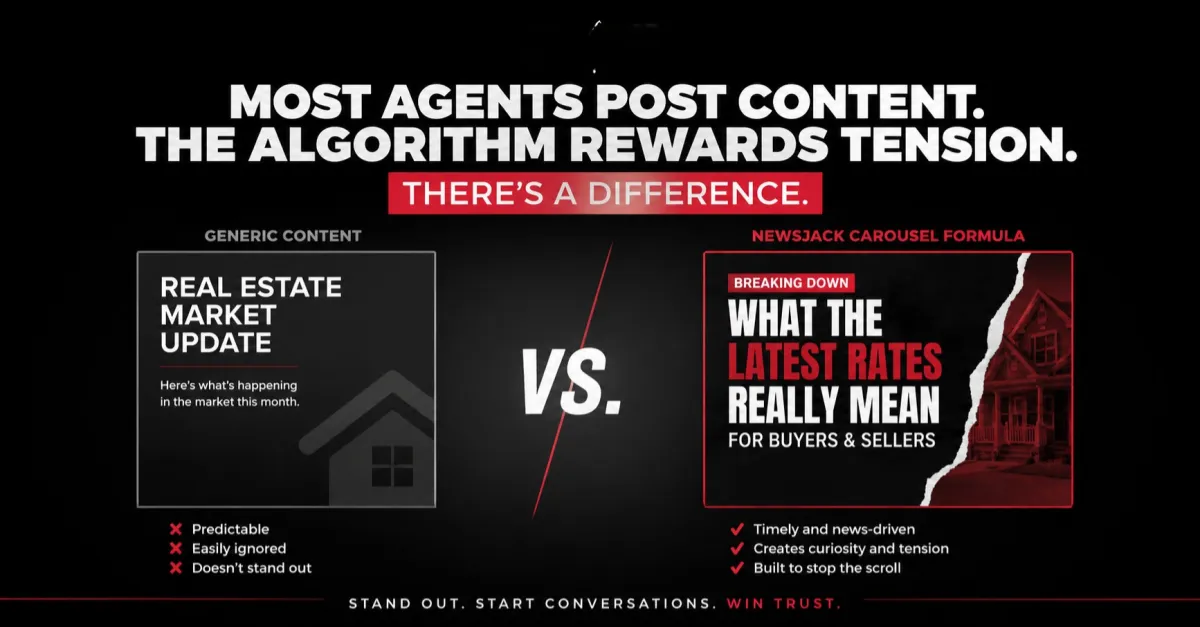
Here's what happened: you posted content. What the algorithm rewards is tension. And most real estate agents have never been taught the difference.
There is a format spreading across Instagram and Facebook right now — in finance, fitness, investing, entrepreneurship — that is generating thousands of saves, hundreds of comments, and avalanches of DMs from people who have never heard of the person posting.
It’s not a paid ad or a viral dance (besides, there are now AI phone apps that can create you doing a viral dance all from a full body image).
It is a carousel built around a specific formula, and it works because it does something most real estate content refuses to do:
It makes the reader feel something before it asks them to do anything.
The formula has a name. Marketers call it newsjacking.
But what's happening in these posts is more surgical than that word implies.
It is not simply "here's a headline, now buy my thing."
It is a five-phase narrative machine that borrows credibility from real journalism, builds tension across multiple slides, delivers a gut punch at exactly the right moment, and then pivots to the agent's actual message.
By the time the reader hits the last slide, they feel like they discovered something. That feeling is what drives the save. The save is what tells the algorithm to show the post to ten thousand more people.
Here is how it works — and how you build one.
Phase 1: The Hook. One face. One outrageous truth. One promise.
The cover slide is not a graphic. It is a provocation.
Pick a recognizable name or image from current news — a Fed decision, a NAR ruling, a local developer making headlines, a tariff story that's touching mortgage rates. Place bold, all-caps text over it that states the uncomfortable truth most people haven't connected yet. End it with a promise: "Here's everything you need to know — and what it means for your next move. SWIPE LEFT."
The job of slide one is singular: make them swipe. Nothing else.

Phase 2: The Build. Real news. Real screenshots. Real proof.
The next few slides are where most agents would write their opinion. Don't.
Instead, use actual screenshots. Screenshot the headline from a real news source. Screenshot the data — a price chart, an inventory graph from your MLS, a Federal Reserve statement. Let journalism do the heavy lifting.
When readers see a real headline embedded inside your post, they don't question your credibility. They borrow it from the outlet you're citing.
Each slide ends with one sentence that adds one more piece to the puzzle and commands another swipe. "But here's what's crazy..." is worth more than three paragraphs of explanation.



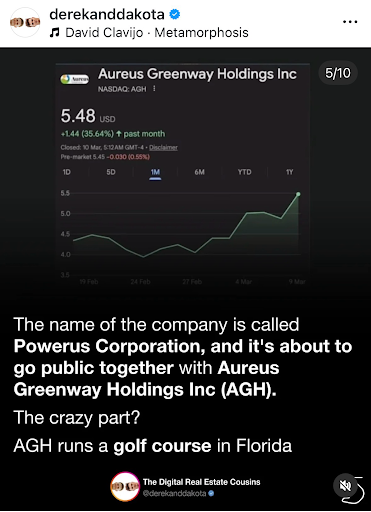
Phase 3: The Gut Punch. Tell them what the hype got wrong.
This is the move that separates agents who build audiences from agents who just post.
Every news story creates a narrative. The gut punch is the moment you show what actually happened versus what the narrative promised.
Rates dropped — and buyers who rushed in that week paid more than buyers who waited sixty days.
Inventory spiked — and sellers who listed in that window sat on market longer than anyone expected.
New construction permits surged — and six months later, resale competition went up, not down.
The gut punch earns trust because it tells the truth. It positions you as someone who reads the market instead of the headlines. It is the reason readers save the post — because it changed something they thought they understood.

Phase 4: The Pivot. Make the news their problem. Make you the solution.
The news story was never the point. It was the vehicle.
Slide eight or nine is where you make the turn: "But here's what most people don't know..."
This is where you introduce the insight, the framework, the conversation — whatever your content is actually designed to lead them toward. A buyer consultation. A listing strategy. A market analysis. A lead magnet. The news story earned the right to be heard. The pivot is where you spend it.



Phase 5: The CTA. One action. One keyword. One result.
The last slide is not a business card. It is a comment trigger.
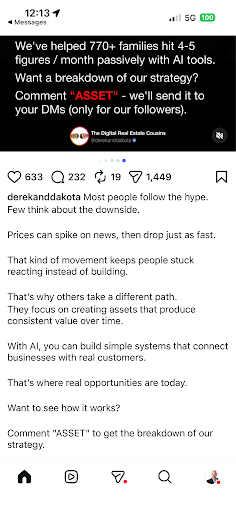
Tell them to comment one word — a keyword that means something to the story you just told — and that you'll send them something valuable in their DMs.
Tools like ManyChat automate this. When someone comments, they get your lead magnet instantly. That comment also tells the algorithm the post is generating conversation, which expands reach to people who have never followed you.
One word. One DM. The loop feeds itself.

The real estate version of this formula isn't complicated. Here's your execution checklist:
Find the headline. Look for a national story touching real estate — Fed decisions, tariff impacts on lumber/materials, NAR policy changes, local zoning news, migration data. The story doesn't have to be local. It has to connect to something your audience already feels.
Screenshot the proof. Find the real headline from a credible outlet. Screenshot it. This is slide two. You are not summarizing the news — you are presenting it.
Identify the gap. What did most people think this news meant? What actually happened? That gap is your gut punch. Find the data (MLS stats, rate history, price trends) that proves the disconnect.
Build your slides. Cover (hook) → News proof → Hidden connection → Data evidence → Gut punch → Pivot → CTA. Aim for 8–10 slides. Each slide gets one idea. Each slide ends with a reason to swipe.
Write the pivot. What do you offer that addresses what the news got wrong? A smarter conversation? A free market analysis? A buyer strategy session? That is slide nine.
Choose your keyword. Pick a word that fits the story (RATES, MARKET, PLAN, MOVE). Set up ManyChat to respond automatically when someone comments it.
Write the caption like it's a standalone post. Hook → Problem → Tension → Solution → CTA. Short sentences. No fluff. If it doesn't land without the slides, rewrite it.
Check the save potential. Before you publish, ask: "Would I save this?" If the answer is no, it's not done. Saves are the metric. Everything else is vanity.
Most agents are waiting for content ideas. The agents closing business from social media are watching the same news everyone else watches — and then asking one question nobody else thinks to ask: what does this story mean for the person I'm trying to help, and why does almost nobody know it yet?
That question is a content strategy. Build the carousel around the answer.