Massachusetts & Rhode Island Price Cuts: Market Correction, Not Crash (2026)
The Lazy Take Is Usually the Wrong One
A lot of people see more price cuts and immediately start whispering the same tired line:
“Uh oh... the market’s crashing.”
No. Not necessarily.
That’s the kind of analysis people use when they want to sound informed without doing the work. It’s headline thinking. Surface-level. Emotion dressed up as insight (or lack of insight).
Or maybe it’s just for online clicks.
A price cut does not prove collapse. Sometimes it signals weakness. Sometimes it signals fear. But a lot of the time, it signals something far less dramatic:
The seller got greedy... and the market declined the invitation.
That’s not a crash. It’s just a correction (or a slap in the face… take your pick). More specifically, it’s the market reintroducing a concept that’s been missing for a while:
Discipline. 😱
More Listings, Longer Timelines, Smarter Buyers
Nationally, the market has loosened compared to last year. Realtor.com’s February 2026 housing report showed active listings up 7.9% year over year. The typical home spent 70 days on market, which was 4 days longer than the year before. And 15.5% of listings had price cuts.
If you’re addicted to doom, that’s enough to get excited.
But here’s the part the panic crowd skips: price cuts were actually lower than a year ago, when 16.8% of listings had reductions.
It suggests this isn’t some dramatic buyer disappearance story. It’s more of a pricing reality story. Sellers are starting to come out of the gate with a little less delusion, instead of listing high, sitting still, then acting shocked when the market doesn’t salute.
In plain English: homes are taking longer, buyers are pushing back, and inflated expectations are getting trimmed. That is not the same thing as a housing collapse. That’s just what happens when the market stops tolerating nonsense.
But, Ryan, is that happening around here? Ummm…
The Northeast Didn’t Get the Memo About “Crash”
I’ve said this before– national headlines are usually a terrible substitute for local intelligence.
The Northeast is still undersupplied in a big way. Realtor.com says inventory in the region remains 54.9% below typical pre-pandemic levels. Price cuts are also the lowest in the country here, at just 8.4% of listings.
That’s not what a distressed market looks like.
Providence is even more revealing. Inventory there remains 61.1% below pre-pandemic norms, while median list price per square foot was up 8.2% year over year.
So no... this is not some broad-based unraveling. This is a market where buyers still want the house, they just don’t want to finance the seller’s imagination.
Massachusetts: Fewer Sales, Not a Fire Sale
Massachusetts tells the same story if you read past the headline.
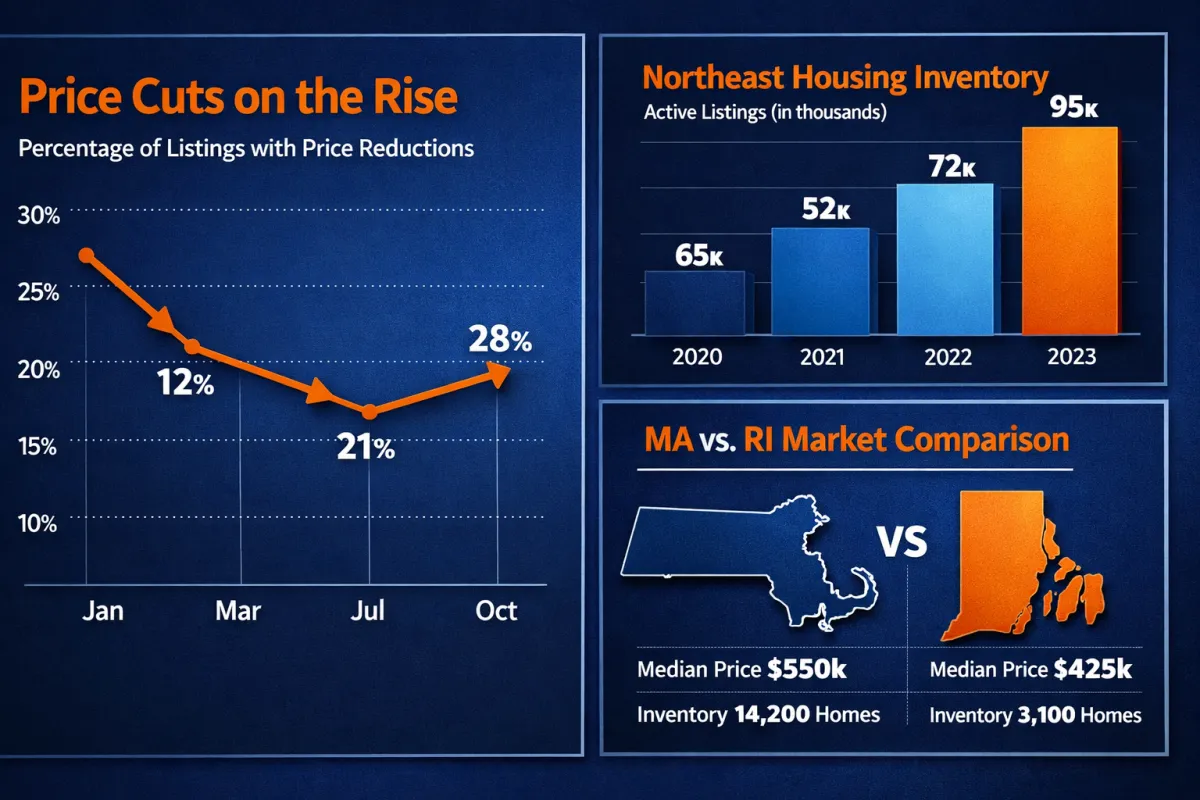
The Warren Group reported that February 2026 single-family sales in Massachusetts fell 8% from a year ago. Sounds dramatic until you look at price: the median sale price slipped just 0.9% to $570,000.
Greater Boston was similar. Single-family sales were down 6.8%, but the median sale price was down only 1.3% to $727,500.
That’s not a market in freefall.
That is a market where transaction volume softened, weather was ugly, affordability is still tight, and sellers no longer get automatic applause for showing up with a roof and a Zestimate.
Rhode Island: Tight Supply Still Wins
Rhode Island may make the point even better.
RI REALTORS reported that January 2026 single-family sales fell 7.3%, the slowest start to a year since 2011. And yet inventory was still just 1.7 months of supply. Median sale price? Up 7.3% to $499,000.
Read that again.
Sales down. Inventory tight. Prices up. That’s supply and demand in action.
That’s not a crash. That’s what happens when there still aren’t enough homes, but buyers have become more selective about which ones deserve a bidding war and which ones deserve a reality check.
The Market Isn’t Punishing Houses... It’s Punishing Ego
For a few years, low inventory covered a lot of sins. Sellers could overprice, underprepare, ignore condition, skip strategy, and still expect the market to rescue them. Sometimes it did.
Heck, there were points over the last few years where I told Sellers not to waste time, energy, or dollars doing any extra prep. Like literally none because it just didn’t matter.
That era is fading… and has been fading. The market is in flux and wants to change but until the inventory issue is solved…
And this is where the buyers have a say. Buyers are dealing with higher monthly payments, higher insurance costs, higher taxes, higher repair costs, and, quite frankly, less tolerance for nonsense. They haven’t vanished. They’ve just become harder to fool.
In other words, they’re more skeptical and more inquisitive.
So when a listing sits and gets cut, that doesn’t automatically mean the market is weak.
Sometimes it means the house was overpriced from day one.
Sometimes it means the photos were bad.
Sometimes it means the updates were better left undone.
Sometimes it means the seller believed 2021 was a permanent reality.
The market isn’t crashing.
It’s filtering.
What This Actually Means for Homeowners
If you own a home in Massachusetts or Rhode Island, the wrong conclusion is: “Values are falling apart.”
The better conclusion is: “The market is less forgiving.”
That’s a totally different story.
Well-positioned homes still get attention. I’ll refer you back to 88 Morgan Dr, Taunton where we received 17 offers, most way over asking and some stupidly over asking.
Well-prepared homes still move. Well-priced homes still create leverage. But overpriced homes, stale listings, and houses sold with blind arrogance are getting exposed faster.
Honestly... that’s a good thing.
A market with no discipline creates delusion… including agents who have a delusion that they actually know what they’re doing having never been through market ups and downs.
A market with some discipline creates decisions.
And right now, decisions are back.
And both buyers and sellers need agents who know how to help them make the right decisions. Agents who’ve been through multiple market cycles.
I’m not saying any of that to put anybody down. I’m saying that the era of simply hiring a body with a license and expecting a glorious victory are over.