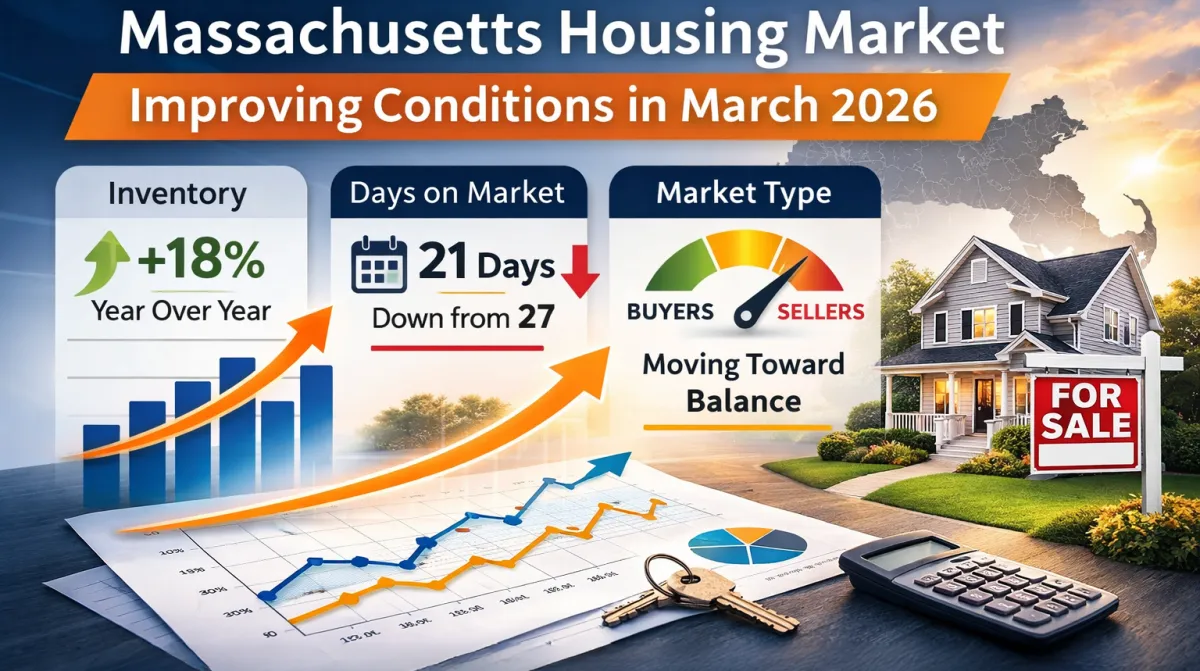
The Market Looks Better on Paper… But It’s Still Not Easy
The Market Looks Better on Paper... But It’s Still Not Easy
More Inventory... Less Panic
The Massachusetts housing market looks better than it did a year ago.
That part is true.
According to MLS PIN’s Massachusetts Area Market Review comparing March 18, 2026 to March 18, 2025, single-family listing inventory rose from 3,330 to 3,703 homes.
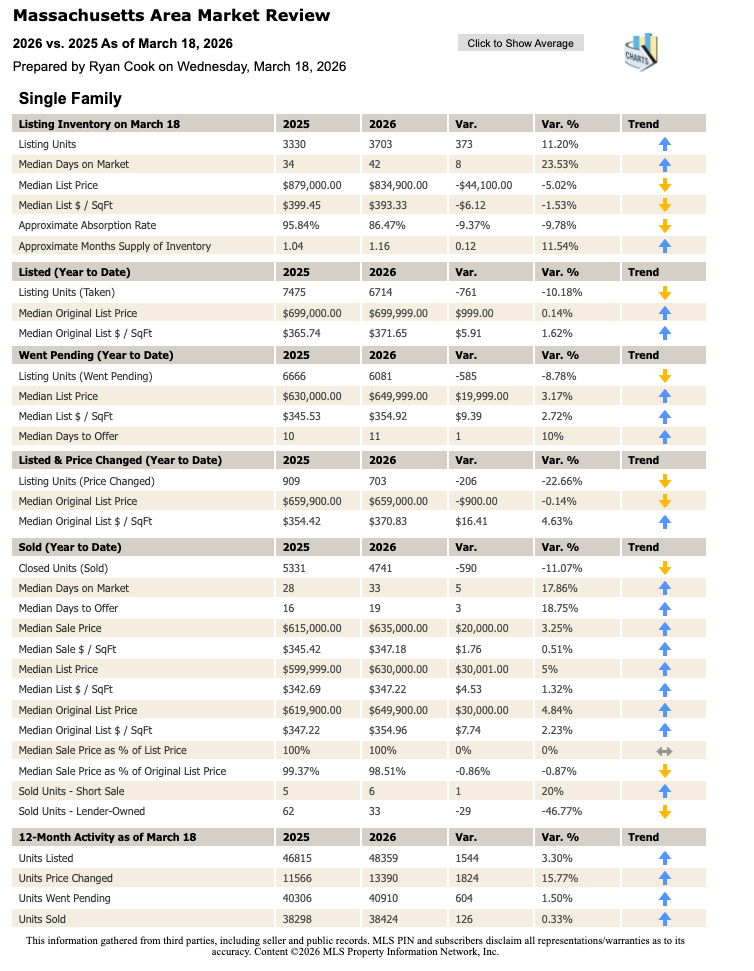
Median days on market climbed from 34 to 42. Months of supply increased from 1.04 to 1.16. The absorption rate fell from 95.84% to 86.47%.
In plain English?
Buyers have a little more room.
Not a lot. A little.
That matters because the last few years were absurd. Buyers were expected to move fast, bid hard, waive protections, and pretend that was normal.
It wasn’t normal.
It was a pressure cooker… and it has been VERY difficult being a buyer’s agent and laying out what it would take to win without wanting to throw up in your mouth.
A Softer Market Is Not a Soft Market
This is where people get confused.
They hear inventory is up and assume the market has flipped.
It hasn’t.
More inventory than last year does not mean abundant inventory. A slower market does not mean an easy market. It means the market is acting a little less insane.
That’s a big difference.
The same MLS PIN snapshot shows median list price fell from $879,000 to $834,900, down 5.02%.
Sale-to-original-list-price slipped from 99.37% to 98.51%.
That may not sound dramatic, but it tells you something important.
Sellers have less room for fantasy.
The market is getting less forgiving.
Prices Are Still High... and Friction Is Still Real
If you want proof this is not some magical buyer-friendly reset, keep reading.
Closed single-family sales dropped from 5,331 to 4,741. That’s down 11.07%.
Median days to offer rose from 16 to 19.
And yet the median sale price still increased from $615,000 to $635,000, up 3.25% year over year.
So yes... the frenzy has cooled.
But affordability has not.
That’s why this market feels so strange.
It looks better on paper because some of the chaos has eased.
It still feels hard because the cost of buying is still high.
What This Means for Buyers
For buyers, the opportunity is not that homes are suddenly cheap.
They’re not.
The opportunity is that the pace may be just slow enough to let you think. To compare. To ask harder questions. To avoid making a panicked decision because you think every house will be gone by dinner.
That alone has value.
And if you’re an entry-level buyer, don’t assume this broader improvement fixes your problem. The lower end of the market is still brutally tight in many parts of Massachusetts and Rhode Island.
That’s a separate issue... and still a serious one.
What This Means for Sellers
For sellers, this is still a strong market.
But it is no longer a market that excuses laziness.
Condition matters.
Pricing matters.
Presentation matters.
If your strategy is to throw a stupid number on the house and hope the market bails you out, that strategy is getting weaker.
You can still win.
You just have to deserve it.
Strategy matters.
Why Mortgage Rates Still Matter
There is another layer here.
Mortgage rates.
I wrote recently about how rate dips during periods of conflict can create false confidence. History shows rates often fall at the start of uncertainty, then rebound as inflation, policy responses, and broader economic pressures work through the system.
That matters because a brief dip in rates does not automatically fix affordability.
It may create a window.
It does not create a miracle.
The Real Takeaway
The market is not crashing.
It is not booming the way it was.
And it is not balanced.
It is simply becoming a little less irrational.
That may not be sexy.
But it is useful.
If you are buying, this may be a better market for discipline than desperation. Of course, that depends on which market and which price band.
If you are selling, this may be a better market for strategy than swagger. I reiterate– strategy matters.
Either way, the people who win in a market like this are usually the ones who understand the difference between better... and easy.
If you want help making sense of what this means in your town, your price range, or your timing, reach out. General headlines are one thing. Your actual market is another.