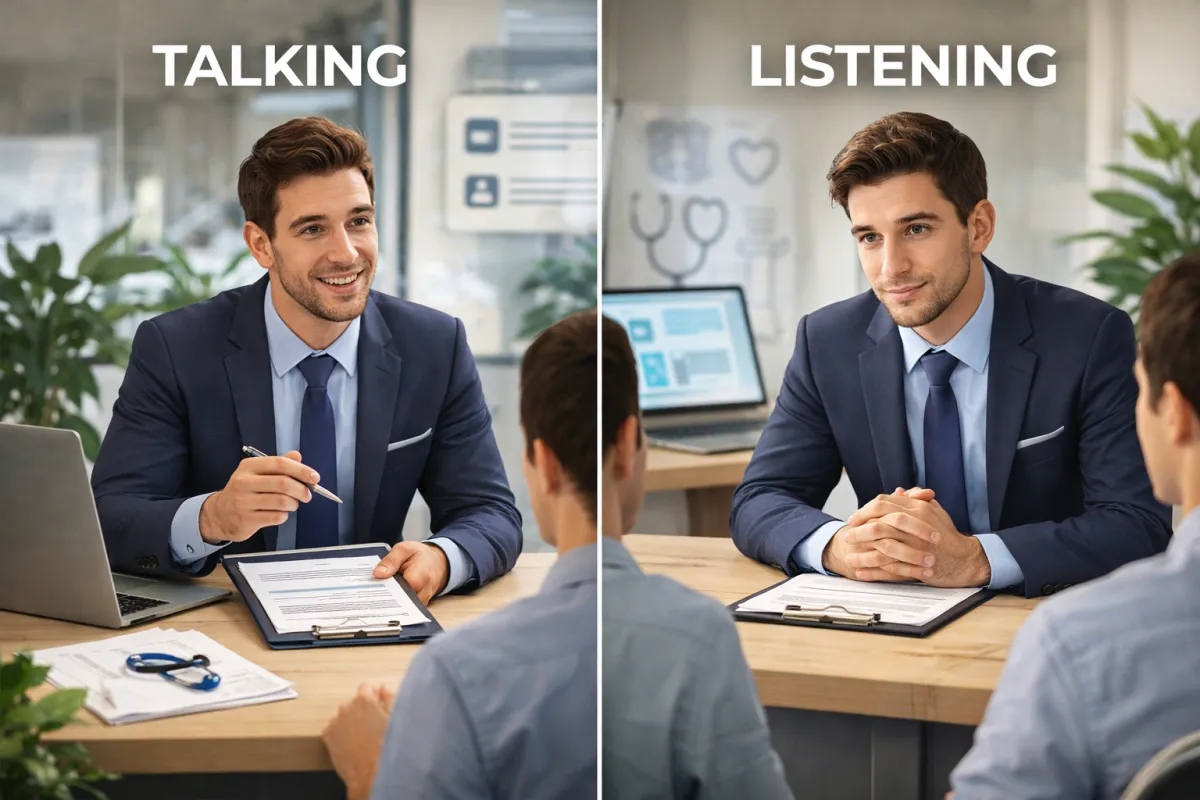
How Real Estate Agents Lose Rapport Before the Conversation Starts
Most agents try to earn trust by talking too soon
Most agents think rapport is something you build by sounding sharp early.
So they walk into the conversation ready to explain the market, prove they know the process, answer objections before they show up, and demonstrate value before the other person has even told the full truth about what is going on.
That may feel polished. It is also one of the fastest ways to lose trust.
Because the second you start prescribing before you diagnose, the conversation stops feeling helpful and starts feeling self-serving.
Prescription before diagnosis is how agents make people feel handled
This is the mistake.
A seller says they are thinking about moving, and the agent immediately starts talking pricing strategy, what’s happening in the market, and starts asking questions about the seller’s home.
A buyer says they are frustrated, and the agent launches into rates, inventory, and competition.
An investor says they want better returns, and the agent starts pitching deals, cap rates, or neighborhoods.
The agent thinks they are being useful.
The client feels “managed.”
That’s a problem.
Because people do not trust you just because you sound informed. They trust you when they feel understood.
Emotion shows up first. Logic comes later. So when your first move is advice, strategy, or explanation, what the other person often hears is not confidence. What they hear is that you are more interested in showing them how much you know than figuring out what is actually true.
That’s not rapport. That’s performance.
The first problem clients mention is usually not the real problem
This is where agents get themselves in trouble.
They respond to the first sentence as if it is the full diagnosis.
Usually it’s not.
A seller saying they want top dollar may really be scared of carrying two mortgages.
A buyer saying they’re just looking may already feel behind, embarrassed, or overwhelmed.
A landlord asking what a property is worth may not actually want a valuation. They may be exhausted. They may be tired of repairs, insurance, tenant issues, or the quiet realization that the property is no longer doing what they thought it was doing.
If you answer the surface statement without uncovering the real issue, your advice can be technically correct and still completely wrong.
I’ve been there. You’ve been there.
And yet we don’t recognize how we screwed up and keep repeating the mistake over and over.
That is why so many agents sound fine and still fail to connect.
Real rapport is built by restraint, not early brilliance
The agents who are best at rapport are usually not the ones trying hardest to sound impressive in the first ten minutes.
(Pay attention all of you DISC high D’s)
The agents who are the best at rapport are the ones with enough discipline to slow the conversation down.
They don’t rush to prove expertise. They work to understand motive, pressure, confusion, timing, fear, and hesitation. They know a real opening conversation is not a stage. It is a diagnostic process.
That means asking questions that force clarity instead of rushing to solutions.
What has you thinking about this now?
What feels most uncertain to you at the moment?
When you say you want to move, what’s really driving that?
What have you already considered that does not feel right?
(And, btw, HOW you ask the above questions matters, too. A sales methodology created by Jeremy Miner called NEPQ can teach you all about that)
Those questions do something most agents skip.
They lower pressure.
They create space.
They lower the other person’s guard because they make the other person feel seen instead of steered.
And that is where trust actually starts.
Expertise only works after the client believes you understand them
A lot of agents get this backward.
They think if they sound smart enough, trust will follow.
Usually the opposite is true.
(I’ve made this mistake more times than I care to admit)
Once someone feels understood, your expertise starts to matter more. Your advice feels earned. Your market knowledge feels relevant. Your recommendations sound like guidance instead of a pitch.
Before that, even good advice can feel premature.
And premature advice creates distance.
That matters in every part of this business. Buyer consults. Listing appointments. Investor calls. First follow-up conversations. If you miss the human reality underneath the transaction, your words may be polished, but they will not feel precise.
Clients are not bringing you clean, rational decisions. They are bringing stress, ego, urgency, fear, hope, confusion, and competing priorities. If you only respond to the transaction, you miss the actual reason the conversation matters.
The agent who diagnoses first usually wins the relationship
If you want better conversations this week, stop trying to sound smart too early.
Do less explaining.
Do more diagnosing.
Be curious before you are convincing.
Because rapport is not built when people hear that you know a lot.
It is built when they feel that you understand enough.
The agent who wins trust fastest is usually not the first one with the answer. It is the one who makes the client feel understood before trying to be impressive.
Diagnose first.
Prescribe second.
That is not just better communication.
That is better business.