The Soundproofing Renaissance: Why “Quiet” Is the New Luxury
🏡 The Soundproofing Renaissance: Why “Quiet” Is the New Luxury (and What You Can Do Now)
Homeowners used to chase open layouts and big airy spaces.
I’ve been writing about how we’ve started to see a change in that design trend. Not that people don’t like “openness”... it’s just the openness makes it hard to understand where one space ends and another begins.
And it makes it hard to decorate and plan your space.
Think of the design shows where the hardest challenge is the open concept design challenge. It terrifies designers.
As a result, more people are chasing something else:
Peace. Quiet. Control.
Especially in New England housing stock — condos, townhomes, older colonials — where sound travels like gossip at a holiday party.
The key idea: soundproofing is not one thing.
There are two different goals:
Absorb sound (reduce echo inside the room)
Block sound (stop noise traveling through walls/ceilings/floors)
Most people accidentally buy products for #1 when they really need #2.
The three levels of “quiet upgrades”
1) “Fast Fix” (DIY weekend)
Best for: echo + minor neighbor noise
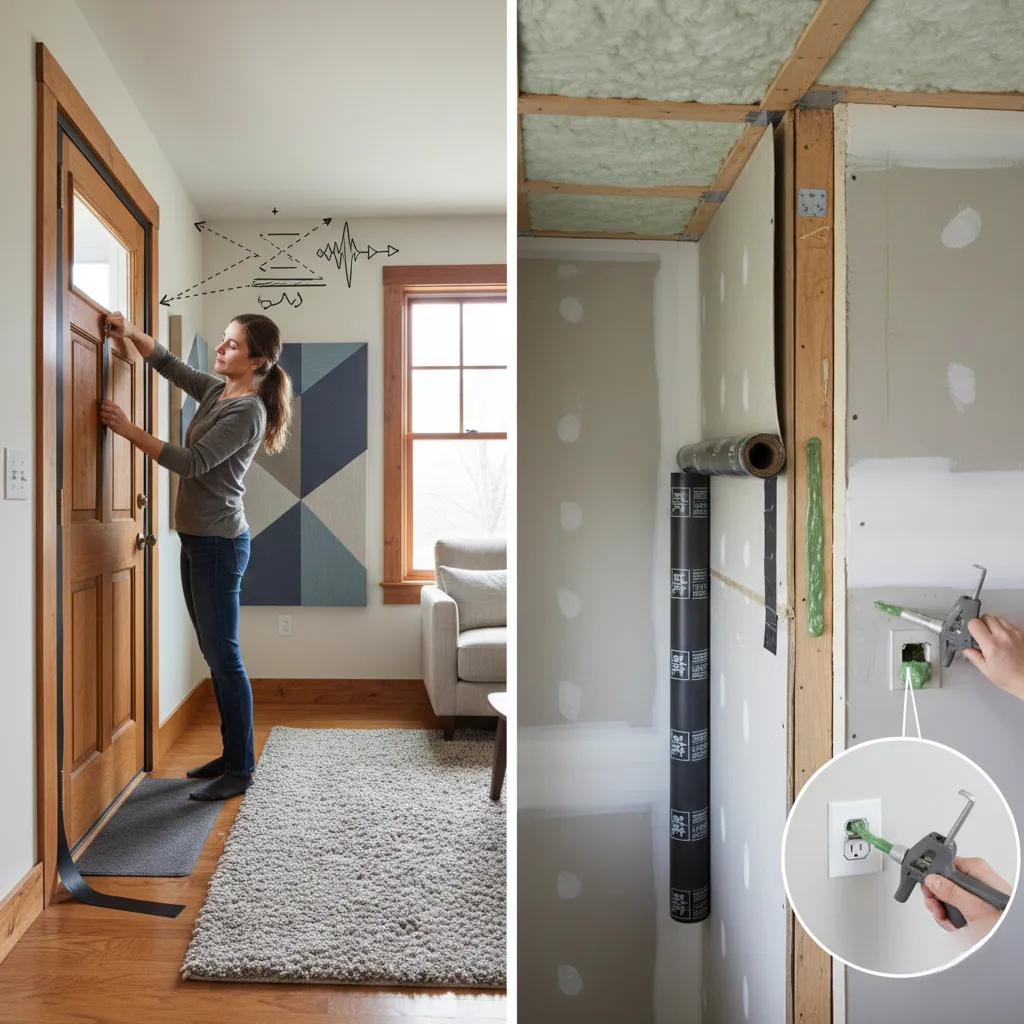
Door weatherstripping + door sweep
Biggest bang-for-buck because doors leak sound, not just your winter heat.Thick rug + pad (especially on hardwood)
Helps impact noise and reduces reflection.Acoustic panels (decorative)
Great for echo, Zoom calls, and “liveliness,” but won’t stop stomping upstairs.
Typical cost range: $50–$500 per room
DIY friendly: Yes
2) “Serious Quiet” (still mostly DIY, but real materials)
Best for: TV noise, voices, general neighbor noise
Mass Loaded Vinyl (MLV) behind a wall layer
Adds mass, helps block airborne sound.Damping compound (like Green Glue) between drywall layers
Converts vibration into heat (yes, that’s a real thing).Sealing gaps (outlets, baseboards, trim cracks)
Sound is sneaky — it finds air leaks.
Typical cost range: $500–$2,500 per room (depending on how deep you go)
DIY friendly: Often yes, but messy
3) “Studio Quiet” (hire a pro)
Best for: shared walls, nurseries, home offices, bedrooms in townhomes/condos
Decoupling (resilient channel, isolation clips)
Stops vibration from traveling straight through framing.

Courtesy: West Coast Sound Solutions
Rebuild “sound wall” assembly
This is what real soundproofing looks like. In the drawing below, you can use Acoustic Mineral Wool instead of regular fiberglass insulation

Courtesy: Soundproofing Company, Inc
Typical cost range: $2,500–$10,000+ depending on scope
DIY friendly: Not really (unless you’re handy and patient)
Product cheat sheet: what to buy for your goal

“Can I do this myself?”
Here’s the honest answer:
✅ Yes, if you’re doing:
door sealing
rugs + pads
acoustic panels
sealing air gaps
adding damping compound + extra drywall in one room
⚠️ Maybe, if you’re doing:
MLV install behind a fresh drywall layer
full-room retrofit (it’s heavy, tedious)
❌ Usually no, if you’re doing:
decoupling ceilings
re-framing wall assemblies
anything involving fire-rated assemblies in condos
What I’d recommend most homeowners do first
If you want the most noticeable improvement for the least money:
Seal the door (weatherstripping + sweep)
Add textile mass (rug + pad)
Treat echo (NRC-rated panels at reflection points)
If still bad: add mass + damping (MLV or second drywall + damping compound)
References
Commercial Acoustics. (n.d.). Mass loaded vinyl sound barrier: When to use & why it works.https://commercial-acoustics.com/guides/mass-loaded-vinyl-sound-barrier-uses/
Zelouf International (Green Glue Company). (n.d.). Noiseproofing compound (Green Glue) – product information & coverage.https://www.greengluecompany.com/noiseproofing-products/compound
TM Soundproofing. (n.d.). Green Glue damping compound tubes (coverage information).https://www.tmsoundproofing.com/Green-Glue-Damping-Compound-Tubes.html
Acoustic Sound Panels. (n.d.). How much do acoustic panels cost?https://acousticsoundpanels.com/pages/how-much-do-acoustic-panels-cost-faq
ATS Acoustics. (n.d.). Acoustic panel NRC ratings (example product specs).https://www.atsacoustics.com/acoustic-eco-panel-24x48x2.html
Indigo Doors. (2025, March 7). Comparison of cost and quality of interior doors.https://indigodoors.com/info/blog/comparison-of-cost-and-quality-of-interior-doors-what-to-pay-attention-to.html
The Home Depot. (n.d.). Masonite solid core interior door slab (example pricing). https://www.homedepot.com/p/Masonite-30-in-x-80-in-6-Panel-Smooth-Solid-Core-Primed-Composite-Interior-Door-Slab-16784/202768988