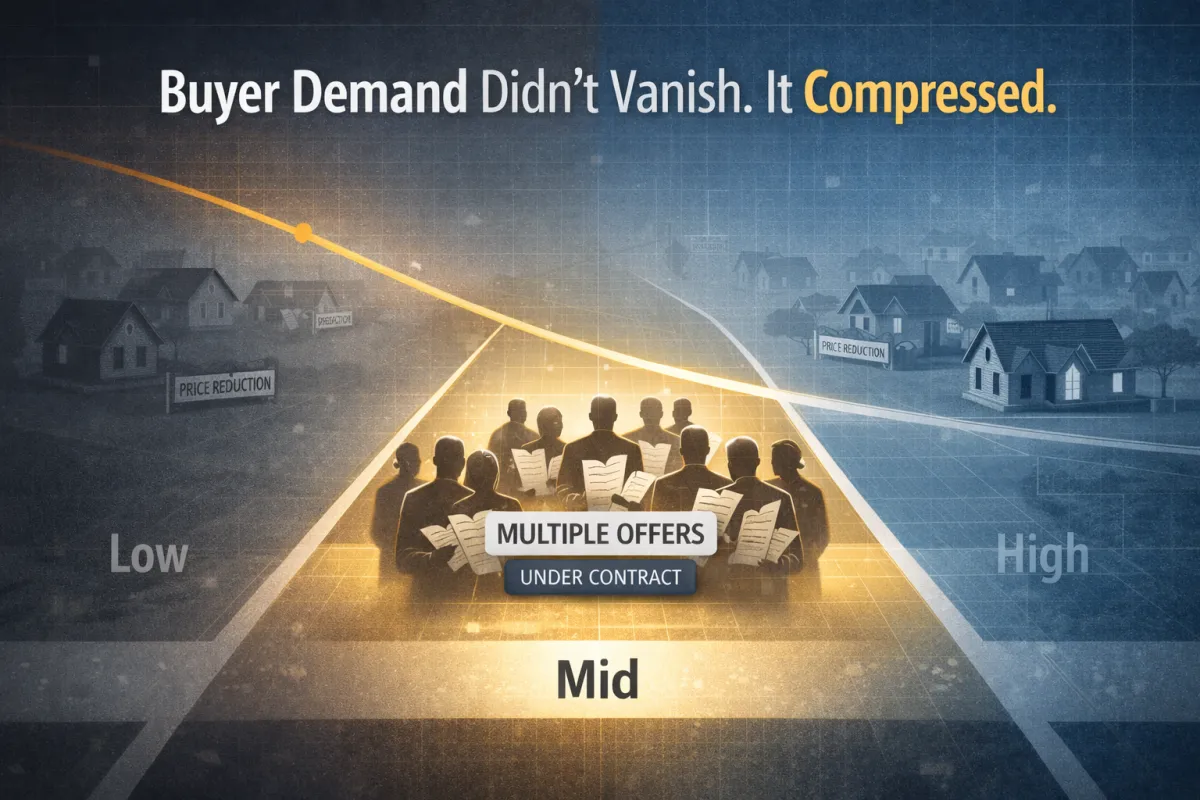
The Compression Effect: Where Buyers Are Still Competing Despite Higher Rates
📊 The Compression Effect: Where Buyers Are Still Competing Despite Higher Rates
If you only read headlines, you’d think buyer demand has vanished.
Rates are high. Affordability is tight. “Buyers are waiting.”
And yet… some homes still sell quickly. Multiple offers still happen (refer back to my post two weeks ago where I mentioned my buyer client’s offer for a property in Lakeville, MA was 1 of 23 offers). Certain price ranges still move with urgency — while others stall out completely.
This isn’t a contradiction.
It’s a compression effect.
The market hasn’t slowed evenly. It has compressed buyer demand into narrower bands — by price, product type, and location. And agents who understand this stop speaking in generalities and start explaining why one home flies while another sits.
That’s where authority lives… and where you can create a following of clients who want to work with you because you’re not a generalist like everyone else.
🧠 What the Compression Effect Actually Is
The compression effect happens when affordability pressure doesn’t eliminate demand — it concentrates it.
As rates rise:
buyers don’t disappear
they narrow their range
they compete harder inside fewer options
Instead of spreading across many price points, buyers cluster where:
monthly payments still pencil
competition feels “worth it”
lifestyle trade-offs make sense
This is why the market can feel “slow” and “competitive” at the same time — depending entirely on where you’re standing.
🔍 Where We See Compression Show Up in the Data
When you look past county-level averages and examine activity more closely, a pattern emerges:
Entry and mid-range price bands continue to absorb listings faster
Move-up and luxury tiers show longer DOM and more price reductions
Buyers are far more decisive once they find a home inside their comfort zone
This creates a misleading narrative:
“Buyers are cautious.”
The reality:
Buyers are selective — and decisive when conditions align.
That distinction matters in every conversation an agent has. The “WHERE” is vitally important.
🗣️ How Agents Use This to Reframe Buyer Risk
Instead of telling buyers:
“It’s a tough market.”
Agents with compression insight say:
“Competition hasn’t disappeared — it’s just concentrated. The question isn’t if buyers are competing, it’s where.”
Instead of reacting to hesitation:
“We can always wait.”
They explain:
“Waiting doesn’t reduce competition in the price ranges buyers still want. It usually increases it.”
This reframes risk away from emotion and toward structure — which is exactly what uncertain buyers need.
🏡 How Agents Use This With Sellers
Compression is just as powerful on the listing side.
Instead of saying:
“The market has slowed.”
A better explanation:
“Buyers are still very active — but only in specific bands. Pricing outside those bands doesn’t buy you time; it costs you leverage.”
This allows agents to:
justify tighter pricing
explain why reductions cluster in certain ranges
position strategy instead of reassurance
Sellers don’t need optimism.
They need orientation. They need to know when they can be aggressive and when doing that is going to punch them in the wallet.
🧭 Why This Matters More Than Headlines
Most market commentary is flat:
“Inventory is up.”
“Rates are high.”
“Demand is cooling.”
Compression explains how those things interact.
It answers the real questions buyers and sellers ask:
Why did that house sell in a week?
Why did this one need three price cuts?
Why does waiting feel safer but perform worse?
Agents who can explain compression don’t sound reactive.
They sound prepared.
🔑 Agent Takeaway
The market isn’t slow.
It’s selective.
I really can’t emphasize how important this is. No matter the market, there are always price bands in specific markets that are performing. ALWAYS.
And selectivity creates opportunity for agents who:
identify where demand is compressed
explain why competition still exists
translate data into decision-making language
This is the bridge between research and authority — and it’s exactly where agents separate themselves from the noise.
🔜 Where This Is Headed
Next week, we’ll take this one step deeper.
Compression doesn’t just happen by price.
It happens by ZIP code.
We’ll look at why county-level stats blur reality — and how ZIP-level insight becomes the ultimate polarization tool for agents who want to own their micro-market.
That’s when research turns into dominance.