MLS vs. Private Listings: What Compass (and Everyone) Is Really Fighting About
🔍 The MLS vs. Private Listings: What Compass (and Everyone) Is Really Fighting About
If you’ve felt the real estate industry getting… weird lately — you’re not imagining it. I’ve had a few agents who’ve been in business longer than 30 years tell me recently that they’re done… that it’s not fun anymore.
The changes, and the weirdness, have really been ramped up in the last 2 years.
Under the hood, one topic has been turning into a huge battle:
When a home is for sale, who gets to know about it… and when?
That question touches everything: seller outcomes, buyer fairness, how appraisals work, and whether the market feels “trustworthy” or “rigged.”
Needless to say, it’s a big deal.
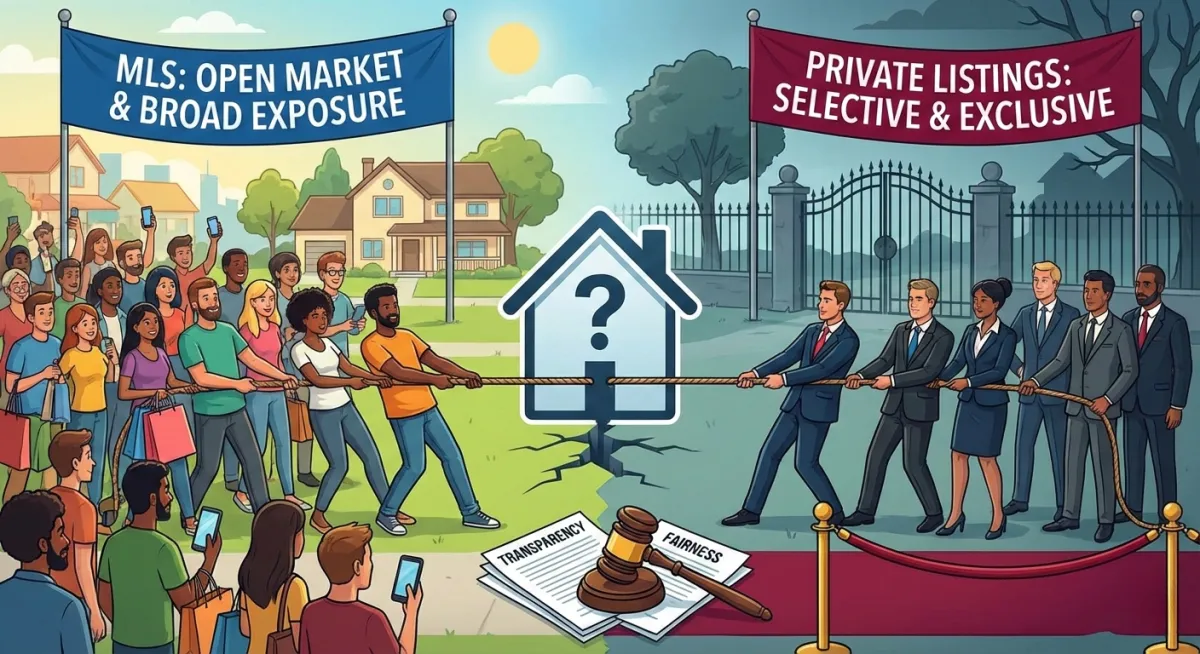
The two paths: broad exposure vs. selective exposure
In most cases, the MLS is the mechanism that turns a listing into a true open-market offering. It creates a common pool of information (price, status, days on market, sale-to-list ratios, comps) and makes that listing visible to the widest set of buyers and agents.
Private listings (often called office exclusives, off-market, or private networks) do the opposite:
They limit who sees the listing early (sometimes to one brokerage, sometimes to a smaller network).
They can delay the moment the market gets a chance to compete.
This isn’t uncommon in the commercial real estate market where cooperation isn’t the norm, but in the residential market there has been a historical “clear cooperation” policy that benefits consumers and the market as a whole.
Why would anyone want “private”?
There are legitimate reasons:
Safety and privacy (celebrity, divorce, security concerns)
Testing price quietly before going public
A seller willing to trade money for privacy (rare, but real)
But the controversy is about something else:
Listings that are publicly marketed in some way, but withheld from the MLS (and/or portals) to control exposure.
That’s where the lawsuits and portal rules collide.
Zillow’s move: “If you market it publicly, don’t pretend it’s private.”
Zillow’s Listing Access Standards drew a line in the sand:
If a listing is publicly marketed but not made widely available through normal channels, Zillow may block that listing from appearing on Zillow/Trulia.
Zillow’s framing is simple:
Truly private is fine.
Public-but-not-available is the problem.
This matters because portals are where many buyers start. Sellers who miss that visibility may reduce competitive pressure — and that can reduce offers, reduce urgency, and weaken appraisal support.
I think the public lacks an understanding of how many professionals, across industries, rely on the data in the MLS to make important, informed decisions. It’s one of the things that make the US housing market such a safe bet for investors around the world.
NAR’s move: “More seller choice… without breaking fairness.”
NAR’s long-standing Clear Cooperation Policy requires a listing to be submitted to the MLS within one business day of public marketing. More recently, NAR introduced a policy designed to give sellers more options, including Delayed Marketing Exempt Listings (often described as “delayed marketing” or “coming soon” options).
I know… this just sounds like garbeldy-gook to you and, if I continued, may put you to sleep. So let me translate: NAR is trying to keep the MLS as the “fair playing field,” while allowing sellers some flexibility — but with guardrails.
Where Compass fits
Compass is one of the biggest advocates for private-network strategies, and it has been in the middle of fights involving MLS rules and portal policies. Heck, they’ve filed lawsuits against some MLSs.
They argue that private listings offer seller’s choice, flexibility, and some control over how their home is marketed.
I think that’s poppycock. Seller’s have always had that ability and, in MA, we’ve had a form from the Massachusetts Association of Realtors® that allows a seller to opt-out of listing their home on the MLS.
The fact is that private listings reduce transparency, create potential unfairness, and fragment the market. And, if I’m being 100% transparent, increases the likelihood that the home will be “double-ended” by the same brokerage increasing their profits.
Listen, I know I should be straddling the line here and saying how both things can be true at once. The problem is that I don’t believe it.
So, the question is: what’s best for the seller in most situations?
The seller’s real trade-off
A seller’s leverage usually comes from one of two things:
Scarcity (unique home, limited inventory)
Competition (more eyes → more showings → more offers)
Private exposure often reduces #2.
Sometimes that’s okay. Often it’s expensive.
Why it can cost sellers money
If 100 buyers could have seen a listing this week, but only 20 did…
then you’re betting that the best buyer is inside that smaller group.
Sometimes they are.
But that’s not how probability works.
Sorry… I’m still a trained engineer with WAY too much math background. And while I don’t claim to be a math genius, it doesn’t take an Einstein to understand the basics of probability - more buyers = the potential for more offers = the potential for better terms.
A practical table: what sellers should choose (and why)

What it means for MA/RI sellers right now
When rates are high-ish and buyers are payment-sensitive:
Competition matters more, not less.
Your first 7–10 days are the most important days that your home will be on the market.
Seller checklist: 5 questions to ask before agreeing to a private-first strategy
If an agent recommends a “private-first” strategy, or if you’re considering it, you’re going to want to know and understand the answers to the below questions:
What’s the exact reason for privacy? (real need vs marketing story)
How long will it be off the MLS? (days? weeks?)
Will it appear on the major portals, including IDX websites, during the private phase?
What’s the plan if showings are weak?
How do you plan to drive eyeballs to my home? Please be specific.
Are we optimizing for the highest price or a controlled experience? (because you can’t maximize both)
How will you let other agents, and the market in general, know about my home
References
National Association of REALTORS®. (n.d.). MLS Clear Cooperation Policy. https://www.nar.realtor/about-nar/policies/mls-clear-cooperation-policy
National Association of REALTORS®. (2025, March 25). NAR introduces new MLS policy to expand choice for consumers. https://www.nar.realtor/newsroom/nar-introduces-new-mls-policy-to-expand-choice-for-consumers
National Association of REALTORS®. (2025). Summary of 2025 MLS changes. https://www.nar.realtor/about-nar/policies/summary-of-2025-mls-changes
Zillow. (2025, April 10). An update on Zillow’s new Listing Access Standards. https://www.zillow.com/agents/listing-access-standards/
Zillow. (2025, September 24). Zillow’s Listing Access Standards: What agents need to know. https://www.zillow.com/agents/agents-know-listing-access-standards/
Real Estate News. (2025, December 23). Compass, NWMLS bicker over discovery in antitrust case. https://www.realestatenews.com/2025/12/23/compass-nwmls-bicker-over-discovery-in-antitrust-case
Inman. (2026, January 20). How strict are the MLSs? Here’s how Compass saw it. https://www.inman.com/2026/01/20/how-strict-are-the-mlss-heres-how-compass-saw-it/
Inman. (2025, June 30). Zillow’s listing ban has begun. Here’s what you need to know. https://www.inman.com/2025/06/30/its-reckoning-day-for-private-listings-what-you-should-know-about-zillows-changes/