Massachusetts Rent Control Debate: Why Housing Supply Still Matters Most
Why rent control keeps coming back
Every time rents rise faster than wages, rent control comes back from the dead.
That’s not hard to understand.
When housing costs are crushing people, a policy that promises to limit rent increases sounds compassionate, immediate, and politically useful. It gives voters something simple to point to and say, finally, somebody is doing something.
That is exactly why Massachusetts is debating it again and, as always, the devil is in the details. Compassion always sounds great but it’s become a euphemism for a way to extract money from the pockets of residents.
Listen… on the surface, the pitch is easy to understand. If rents are too high, cap the increases. If tenants are getting squeezed, stop landlords from raising rents too fast.
The problem is that housing markets don’t care whether a policy feels fair. They respond to incentives, constraints, supply, cost, and risk. That is where rent control starts to fall apart.
Real estate is local, but supply math is still supply math
We say all the time that real estate is local.
It is.
Massachusetts is not Texas. Rhode Island is not California. Boston is not Phoenix. A triple-decker market in Fall River does not behave like a luxury rental tower in Cambridge.
But local does not mean immune to economics. In the end, the math still has to math, right?
If you make it harder to earn a return on rental housing, some owners will stop improving units because they can’t make their money back. Some investors will stop building because their return on investment is too low making it to risky. Some landlords will convert, sell, or simply avoid the market altogether.
And when supply gets tighter in a market that already does not have enough housing, affordability usually gets worse, not better.
Am I making sense? This isn’t hard. It’s not like people don’t have a choice of where to put their money. When they can’t earn a return on their investment, they’ll move that money to another investment that isn’t real estate.
That is the part advocates rarely take the time to understand. They live in La La Land filled with unicorns and rainbows where actions have zero consequences.
And the reality is that most voters don’t care about the details nor do they have the attention span to dig in. They need one-line slogans, memorable catch phrases, and social media memes that are easy to share.
And making landlords, investors, and builders out to be the proverbial “Bad Guys” is easy to do and politically expedient.
Massachusetts has already tried rent control before
This is not some brand-new policy experiment.
Massachusetts had rent control for years in Boston, Brookline, and Cambridge before voters ended it in 1994.
That matters, because too many policy conversations act like every old idea is new if you rename it "stabilization." Or they argue that the implementation was wrong and that they’ve figured it out and, therefore, THIS TIME it’s going to work.
The argument then was the same argument now. Protect tenants. Prevent displacement. Keep housing affordable.
Those goals are understandable. Who could argue with them?
The problem is that the policy did not solve the underlying shortage. It regulated price pressure without fixing the conditions creating the pressure in the first place.
What happened when other markets tried it
If rent control were the answer, we would expect the places that used it most aggressively to become models of affordability, right? The little slice of Utopia they’ve all dreamed of.
That is not what happened.
In Cambridge, research from the National Bureau of Economic Research (NBER) found that ending rent control was followed by substantial reinvestment and a major increase in housing values, not just in formerly controlled properties but in nearby properties too. The estimated effect on Cambridge housing values over time was enormous. That does not mean every tenant benefited in the short run. It does mean the policy had been suppressing investment and distorting the market.
In San Francisco, Stanford researchers found that expanded rent control helped some existing tenants stay in place, but landlords responded by reducing the supply of rental housing. Some converted units, some redeveloped, and some shifted away from the affected segment of the market. The result was fewer rental units available over time and more upward pressure on citywide rents.
That is the pattern that keeps showing up. I could cite more examples in Maryland, Oregon, and Minnesota… but I’d just be repeating the same point.
Rent control can help a subset of current tenants in the short term.
But when it discourages new supply, reduces mobility, and weakens reinvestment, it often makes the broader affordability problem… wait for it… worse.
Why rent control fails to solve the real problem
The real problem is not that landlords woke up one day and randomly decided to charge more. A healthy market sets the prices and the landlords need to compete for the best tenants. A landlord can’t just set a random price well beyond what the market can sustain.
The real problem is that we don’t have enough housing in the places people want and need to live. Why?
The shortage has been made worse by well meaning, but disastrous, zoning restrictions, slow permitting, neighborhood opposition, construction costs, insurance costs, labor shortages, infrastructure limits, and years of underbuilding. Never mind ever burdensome, yet well intentioned, regulation that drives up the costs.
Rent control does not fix any of that.
👉 It does not create more units.
👉 It does not speed up approvals.
👉 It does not lower lumber, labor, insurance, or financing costs.
👉 It does not magically turn anti-growth local politics into pro-housing policy.
What it often does is create a false sense that the affordability problem is being addressed (because it makes the voters feel all warm and fuzzy inside) while the supply problem keeps getting worse underneath it.
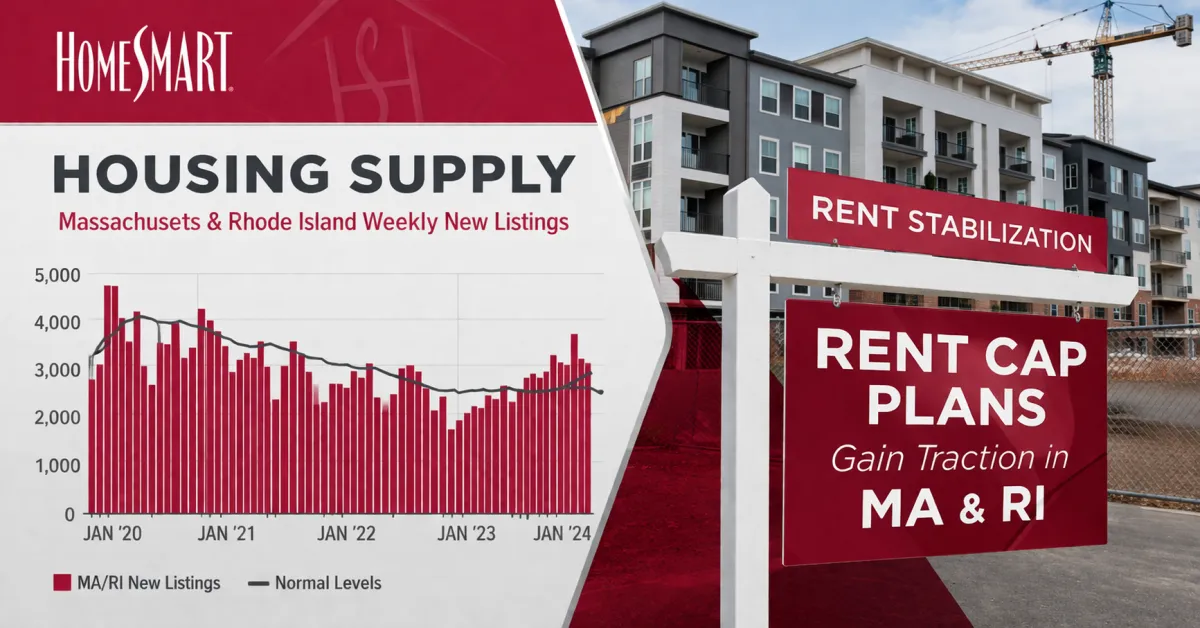
That is why this issue matters so much in Massachusetts and Rhode Island. These are not markets drowning in excess housing. These are constrained, expensive, heavily regulated markets where it’s already hard, if not damned near impossible, to add inventory fast enough.
(and don’t even get me started on the fact that the “housing” be added is, inevitably, rental units and not ownership units)
Confucius once said, “Life is really simple, but we insist on making it complicated.”
If you want lower housing costs, you need more housing!
That’s not a slogan. It’s everything.
What could actually work better
If policymakers are serious about affordability, there are better targets.
Legalize and encourage more housing types
Speed up permitting
Reduce friction for multifamily and infill development
Support accessory dwelling units that actually get built
Create predictable rules near transit and job centers
Use targeted assistance for renters in crisis instead of broad policies that distort the entire market (FYI: Broad Policies Never Work!)
Reward production
Punish delay
In fairness, some of these items are proposed bills in the Massachusetts Legislature either sent out to a study commission, or that have recently returned from a study commission.
But we all know that sending something out to study means they don’t want to do it… so they slow walk it until people forget about it.
Make it easier to build, easier to convert, easier to add units, and easier to say yes where local politics has spent decades saying no.
That is harder than passing a cap. It’s not something that’s easily turned into a campaign slogan and doesn’t make people show up to the polls (or donate money).
It is also more likely to work.
Bottom line
Rent control is attractive because it offers immediate emotional relief.
But housing policy should be judged by outcomes, not intentions. I know… outcomes mean you need to perform and then the issue isn’t something a politician can run on anymore.
You know… like how real businesses have to perform in order to stay in business?
Massachusetts can call it rent control or rent stabilization. The label is not the point.
The point is whether it increases supply, improves affordability, and creates a healthier housing market over time.
History suggests it does not.
If the goal is lower costs and more stability, the answer is not to squeeze harder on too few units.
The answer is to create more of them.
Don’t make it any more complicated than that… because it’s not.
Sources
Ballotpedia: Massachusetts Rent Control Initiative (2026)
Massachusetts initiative petition text
NBER: The End of Rent Control in Cambridge
Stanford GSB: Effects of Rent Control Expansion in San Francisco
Brookings: What does economic evidence tell us about the effects of rent control?
Massachusetts Affordable Homes Act