Massachusetts Home Insurance Is Becoming a Real Estate Price Ceiling (And Most Homeowners Don’t See It Yet)
Massachusetts Home Insurance Is Becoming a Real Estate Price Ceiling (And Most Homeowners Don’t See It Yet)
If you’re still thinking the only thing that can kill a deal is price… you’re going to get blindsided.
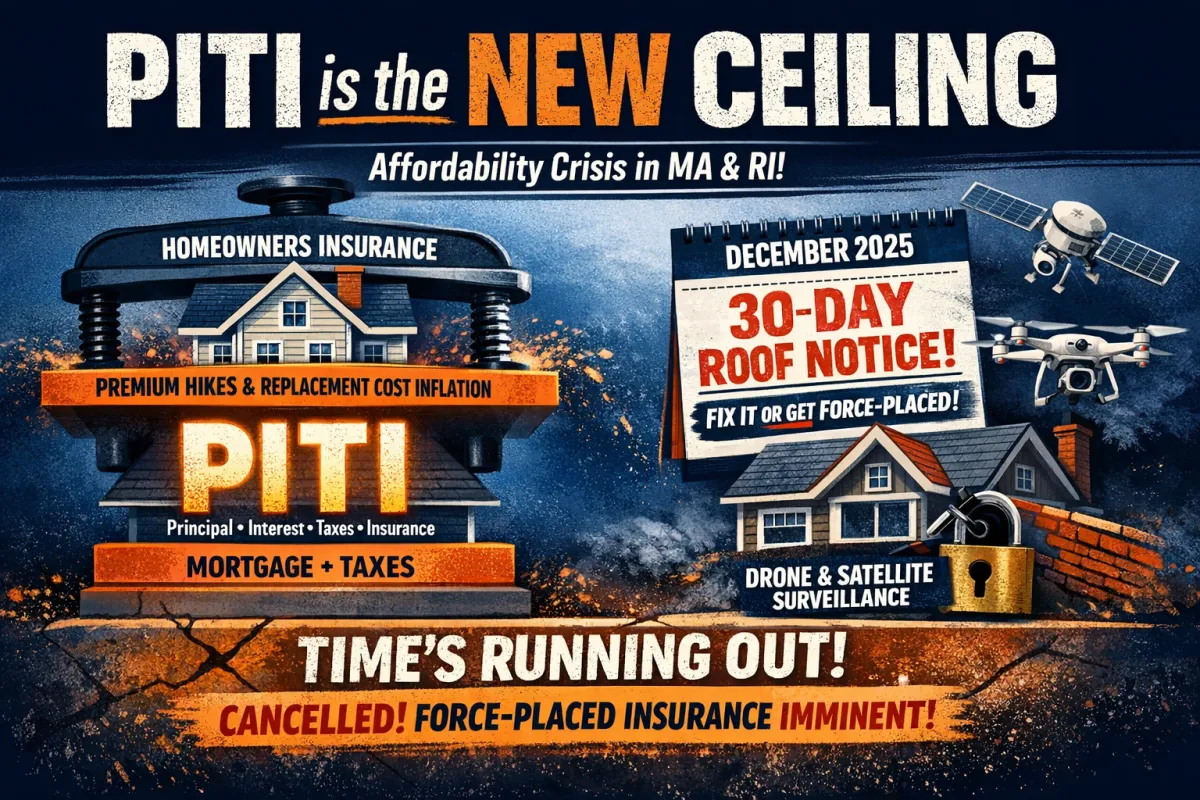
Because the market is shifting in a quieter, nastier way: homeowners insurance is starting to act like a hard ceiling on affordability — not in Florida, not in California… here. In Massachusetts and Rhode Island.
I had this exact conversation recently with Jay Barrows (Barrows Insurance, Mansfield) and it confirmed what I’ve been watching creep into more and more transactions: Insurance isn’t background noise anymore. It’s underwriting. It’s leverage. It’s deal friction. And it’s starting to cap what buyers can pay.
PITI (Principle + Interest + Taxes + Insurance) has been a real problem causing REAL affordability issues.
This is one of those changes that doesn’t show up in the headlines until it’s already cost people real money.
Why Home Insurance Premiums Are Rising in Massachusetts and Rhode Island (It’s Not Just “Greedy Insurance Companies”)
Most homeowners are shocked by premiums right now, and the shock is real. But the “why” matters, because it tells you whether this is a temporary spike or an actual structural shift.
Replacement cost is exploding. Labor costs are way up (because all of our other cost of living costs are way up… oil/gas, electricity, groceries, property taxes and Prop 2-½ overrides in MA) and material costs are sky high. Heck, I was quoted $200/yd this week for concrete for a project I’m looking at and in 2017 it was about $70/yd (and about $90/yd for winter mix). That’s almost a 3x increase!
Insurance doesn’t care what you paid for the house. It cares what it costs to rebuild it.
And rebuild costs have changed:
Labor costs are up.
Supply costs are up.
Scheduling is slower.
Trades are harder to book.
“Simple” repairs turn into “open the wall and now we’re in it.”
So when replacement cost goes up, premiums go up. Even if your house didn’t change. Even if you never filed a claim. Even if you’re a “good customer.”
Carriers are getting more aggressive about risk
This is the part most people don’t understand until it happens to them:
Insurance companies are not just pricing risk. They’re policing risk.
They’re tightening standards on things that used to slide:
Roof age and condition
Exterior condition
Trees overhanging rooflines
Signs of prior water intrusion
Deferred maintenance that signals “future claim”
And they’re doing it faster and more impersonally than ever.
The New Reality: Drones, Satellite Imagery, and 30-Day Notices
Here’s the story that should scare every homeowner with an older roof into paying attention.
A client of mine got a notice around Christmas 2025: he had 30 days to replace his roof or the policy would default.
Not “sometime this year.”
Not “when you get around to it.”
Not “we’ll renew you but at a higher premium.”
Thirty days.
I received a similar notice a few years ago and it’s full-on panic time!
He had to borrow money to do it — because the alternative wasn’t “higher insurance.”
The alternative was no insurance.
And if you have a mortgage, “no insurance” isn’t a lifestyle choice. It’s a crisis.
Why a lapsed policy is a mortgage problem, not an insurance problem
If your policy cancels and you have a mortgage, the lender doesn’t shrug and say “good luck.” You either get insured or they will call your mortgage.
So they force-place insurance.
Force-placed insurance is usually:
More expensive
Worse coverage
Designed to protect the lender, not you (they do not care about you - they care about their investment)
So the homeowner gets hit twice: higher cost, weaker protection.
That’s the “terrible” part. It’s not theoretical. It’s financial stress, fast.
How Insurance Becomes a Price Ceiling in Real Estate
Most people still do affordability math like it’s 2019:
“What’s the rate?”
“What’s the price?”
“What’s the payment?”
But today, buyers don’t qualify for principal and interest. They qualify for the whole monthly reality:
Principal + interest
Property taxes
Homeowners insurance
Utilities
HOA (if applicable)
And insurance is the line item that’s becoming unpredictable.
The Zillow payment is fantasy math
Online estimates often assume insurance is some stable, generic number.
Newsflash: It isn’t.
So a buyer falls in love with a house at $X because the payment “looks fine”… then the insurance quote shows up and the payment jumps.
And here’s what happens next:
The deal doesn’t die immediately.
It gets wobbly.
The buyer starts asking for credits.
The buyer gets skittish about inspection items.
The buyer starts looking for an exit that doesn’t make them feel stupid.
Insurance becomes silent leverage.
What Sellers Need to Understand (Before They List)
If you’re selling, the question isn’t just:
“Will it show well?”
It’s:
Will it underwrite cleanly?
Because buyers are not just buying your kitchen. They’re buying your risk profile.
Yes, I said it.
The homes that get punished first
Insurance friction tends to show up faster on properties with:
Older roofs (or roofs that “look” older from above)
Visible exterior wear
Overhanging trees
Prior water issues
Older electrical concerns
Anything that signals deferred maintenance
Even if the house is perfectly livable.
Even if it’s charming.
Even if it’s “fine.”
Insurance doesn’t price charm. It prices risk.
The smartest pre-list move nobody wants to do
Before you list, you should be asking:
“Is my roof going to trigger underwriting?” (especially for FHA or VA financing)
“Is there anything visible from above that looks like a problem?” (yes, insurers are using drones to check it out)
“If a carrier got picky, what would they pick on?”
You don’t need to renovate your whole house.
You need to remove the obvious excuses for an insurance company to get nervous — because that nervousness becomes your buyer’s problem, and then it becomes your negotiation.
What Buyers Should Do (So They Don’t Get Ambushed)
If you’re buying, don’t wait until you’re emotionally attached to a house to learn the insurance story.
That’s like waiting until after you propose to ask if your partner wants kids.
Ask earlier than you think you need to
The right time to think about insurance is not after inspection.
It’s when you’re narrowing down the finalists.
If you’re serious about a home, you want to know:
Roof age / condition (not just “seems fine”)
Heating type
Any prior water issues
Any obvious exterior risk factors
Because the worst-case scenario isn’t “higher premium.”
The worst-case scenario is “fix this in 30 days or lose coverage.”
It’s no joke. Like I said, I’ve lived it.
The Trend to Watch in 2026: Financeable Homes Win
We’re moving into a market where the best-looking listing doesn’t automatically win.
The listing that wins is the one that’s easiest to finance cleanly:
clean inspection
clean appraisal
clean underwriting
clean insurance
That’s the new stack.
And insurance is now part of underwriting whether people like it or not.
What To Do Next (If You Want to Avoid the Pain)
If you want a quick gut-check, reply with:
Town
Approximate age of the home
Heating type (oil / gas / electric / propane)
Roof age if you know it (or “unknown”)
And I’ll tell you what typically triggers insurance issues — and what I’d want to verify early if you were buying or selling.
Because the people who get hurt in this market aren’t the ones who “picked the wrong paint color.”
They’re the ones who got blindsided by the stuff nobody talks about until it’s too late. This is what happens when you work with a “generalist” who simply pays to advertise online but brings little technical skill to the process.