ADUs Are “Allowed By Right” in Massachusetts… and Homeowners Are Already Misunderstanding What That Means
ADUs Are “Allowed By Right” in Massachusetts… and Homeowners Are Already Misunderstanding What That Means
In August 2024, Massachusetts made ADUs “allowed by right” in single-family zoned areas across the Commonwealth.
And a lot of homeowners heard that and translated it as:
“Great. I can build a little apartment and instantly add value.”
That’s the misunderstanding that’s going to waste a lot of time (and in some cases, a lot of money).
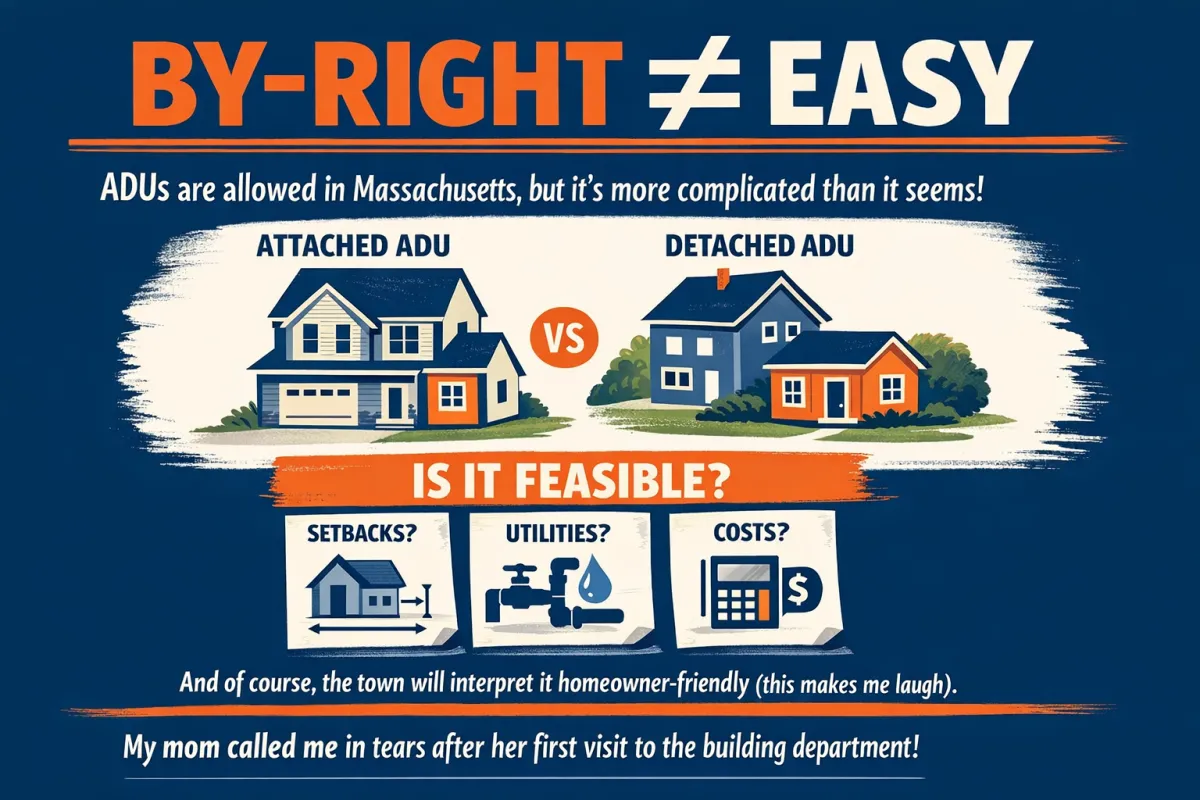
Because “allowed by right” doesn’t mean “easy,” “cheap,” or “approved the way you imagine it.” It means the zoning door is open. The rest of the process still has plenty of locks on it — and some towns are still trying to keep that door half-closed with overly restrictive local rules.
What “By Right” Actually Gets You (and What It Doesn’t)
Here’s what by-right does mean in plain English:
You’re not begging for a special permit just to have the concept of an ADU.
You have a clearer legal footing than you did a few years ago.
Here’s what it doesn’t mean:
You can ignore local zoning details.
You can ignore building code.
You can ignore utilities, septic, access, parking, or life-safety requirements.
You can assume the town will interpret the rules in the most homeowner-friendly way. (This one makes me laugh)
ADUs Are a “Both” Play: Income + Value… With a Catch
Yes, ADUs can be an income play (rent, aging parent, adult child, caregiver). And yes, they can be a value play.
But the catch is that value isn’t automatic. Value shows up when the ADU is legal, functional, and doesn’t create headaches for the next buyer.
An ADU that feels like a clean, normal second unit can add real appeal.
An ADU that feels like a weird, cramped, over-customized “project” can do the opposite.
The 3 Questions You Need to Answer Before You Get Excited
1) Can you build it legally on your specific lot?
“By right” doesn’t override physics or site constraints. Lot layout, setbacks, access, and existing nonconformities still matter.
2) Can you build it safely and to code without a budget explosion?
This is where people get hurt. Egress, fire separation, ceiling height, stairs, electrical upgrades, and utility capacity can turn a “simple” ADU into a real construction project fast.
3) Will it be seen as an asset… or as complexity?
If you sell in 3–7 years, will the next buyer say “this is awesome” — or “what is this going to cost me to deal with?”
The Right Mindset (So You Don’t Build an Expensive Hobby)
The right question isn’t “Can I build an ADU?”
It’s:
Can I build this legally, safely, and profitably — and will it still be a win when I sell? (Unless you have a money tree growing in the back yard, this is a real consideration)
If you’re considering an ADU, reply with your town and whether you’re thinking attached (basement/over-garage) or detached (backyard). I’ll tell you the first feasibility checks I’d run before you spend a dime.
I went through this already when my mom was living with us. It wasn’t going to be easy nor cheap and, in the end, it made no sense for us.