Is Finishing the Basement Actually Worth It?
Is Finishing the Basement Actually Worth It?
The HGTV Fantasy vs. Real Life
A lot of homeowners look at an unfinished basement and see “free square footage.”
A future playroom. Guest suite. Home office. Gym. Movie room. Maybe even that mythical “extra living space” every listing seems to promise right before you walk downstairs and find low ceilings, one sad light bulb, and the unmistakable smell of 1987.
The idea sounds simple: finish the basement, add value, win.
But that’s not how this usually works.
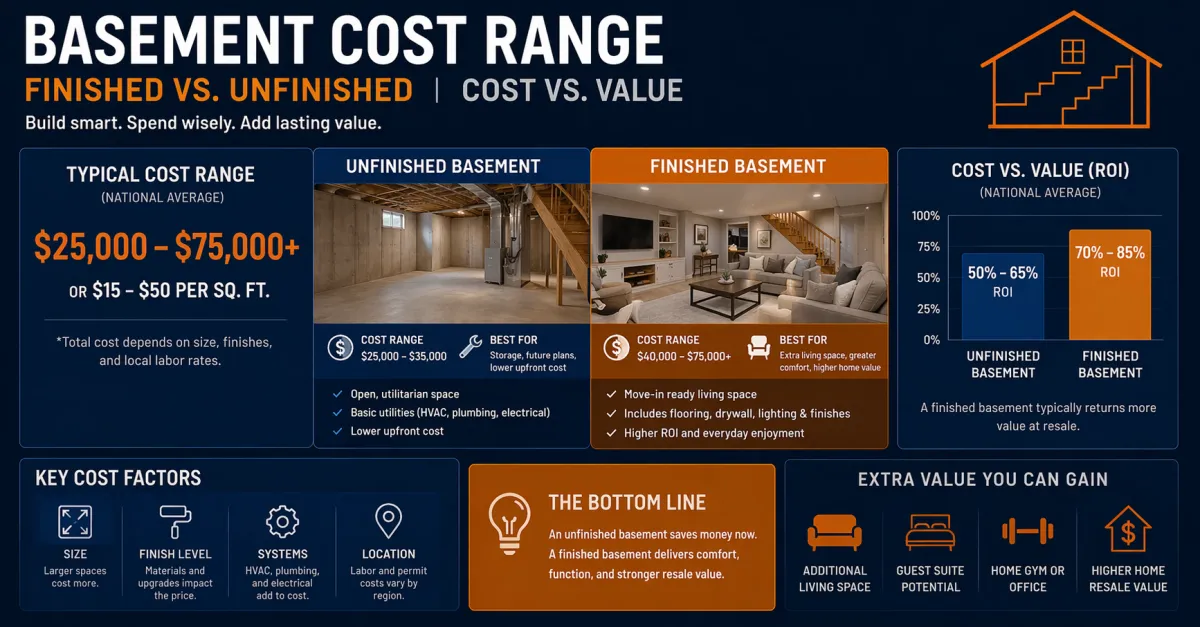
A finished basement can absolutely make your home more useful. It can make it easier to live in, easier to market, and in some cases easier to sell. But if you think spending $40,000 to $80,000 downstairs automatically adds $40,000 to $80,000 in resale value... that’s where the fantasy starts.
What It Actually Costs
Let’s start with the part contractors don’t always love putting in giant letters: basement projects are not cheap.
National remodeling data consistently shows that basement finishing is a meaningful investment, not a casual weekend upgrade. Depending on the scope, layout, moisture issues, ceiling height, electrical work, insulation, flooring, egress requirements, and whether you’re adding a bathroom, homeowners can easily spend tens of thousands of dollars.
A reasonable public-market planning range for a basement finish is often somewhere around $40 to $90+ per square foot, with more complex or higher-end projects pushing beyond that. If you’re carving out multiple rooms, adding plumbing, fixing water issues, or trying to make the space feel like true main living area instead of “the nice basement,” the number can climb fast.
That means a 700-square-foot basement might cost roughly:
$28,000 at $40/sf
$42,000 at $60/sf
$63,000 at $90/sf
Add a bathroom, better finishes, or problem-solving work... and now you’re in the range where people start saying things like, “Well, since we’re already doing it...,” which is usually how budgets go to die and why contractors always seem to have really nice trucks.
Here’s the Part Homeowners Get Wrong
People often assume added space equals added value in a clean, dollar-for-dollar way.
It doesn’t. Like rarely ever.
In most markets, below-grade finished space is not valued the same way as above-grade living area. That doesn’t mean it has no value. It means the market usually treats it differently.
Why? Because buyers do.
A finished basement can be a huge plus for lifestyle. It may give a family a second hangout area, a teen zone, a guest overflow space, a workout room, or a quiet office. That matters. But when buyers compare homes, they usually still place a premium on above-grade square footage first. A beautiful lower level helps... but it usually does not erase the fact that it is still downstairs.
That’s why basement projects often create strong utility value and only partial resale recovery.
The Public-Market Approximation... and Why It Has Limits
In the spirit of being fully transparent, this part is a public-market approximation, not MLS-perfect science. If you look hard enough, you’ll find sales that bucked the trend and defy logic.
Why? Because square footage reporting is a giant pain in the butt.
Agents report space differently. Some include finished lower-level areas more clearly than others. Some listings emphasize “additional finished space” without breaking out exactly how it compares to above-grade living area. Some buyers care deeply about a finished basement; others barely count it unless it solves a specific need.
So when we compare homes with similar above-grade space and different lower-level finish, we’re looking for directional market behavior, not pretending we’ve produced an appraisal.
And the directional takeaway is usually this:
finished basements tend to improve appeal and marketability more reliably than they produce full cost recovery.
What the Market Usually Rewards
If two homes have similar above-grade size, layout, location, and condition, and one has a clean, functional finished basement while the other has bare concrete and storage bins from the Clinton administration, the finished one often has an edge.
That edge may show up as:
stronger buyer interest
more perceived flexibility
a faster sale
a modest price premium
better emotional response during showings
But “an edge” is not the same thing as “full payback.”
If you spend $50,000 downstairs, the market may not hand you back $50,000 just because you installed recessed lights, gray LVP, and a sectional big enough to host the Super Bowl. Buyers may like it. They may even choose your house because of it. But they still tend to discount below-grade space relative to true main-level living area.
So... Is It Worth It?
Sometimes yes. Sometimes absolutely not.
If you are finishing the basement because:
your family genuinely needs the space
you plan to stay long enough to enjoy it
the rest of the house works well and this solves a real lifestyle problem
the basement is dry, functional, and finishable without major hidden issues
...then it can make a lot of sense.
If you are finishing the basement because:
you think it’s a magic resale machine
you’re over-improving for the neighborhood
the space has moisture, low ceilings, awkward access, or limited natural light
you’re doing it mainly to “make the Zestimate go up”
...you may be setting money on fire… but in a very organized way.
The Better Question to Ask
Don’t ask:
“Will I get my money back?”
Ask:
“How much of this investment is for resale... and how much is for my own quality of life?”
That’s the real decision.
Because if the basement gives you five years of better living, less crowding, more flexibility, and a more marketable house later, that may be worth plenty.
But if you’re expecting a clean financial win on resale alone, you should go in with your eyes open: the market usually says, “Nice upgrade... but not full price.”
Bottom Line
Finishing a basement can be worth it.
Just not always in the way homeowners hope.
It often creates real lifestyle value. It can create real marketing value. It may even create some resale premium.
But it usually does not behave like above-grade square footage, and it rarely deserves the fantasy math homeowners use when they start pricing out drywall and luxury vinyl plank.
In other words: finish the basement if it solves a problem.
Don’t finish it because you think the market is dying to reimburse your renovation optimism.