Induction Cooking: The Kitchen Upgrade Buyers Don’t Expect to Love
Induction Cooking: The Kitchen Upgrade Buyers Don’t Expect to Love (Until They Do)

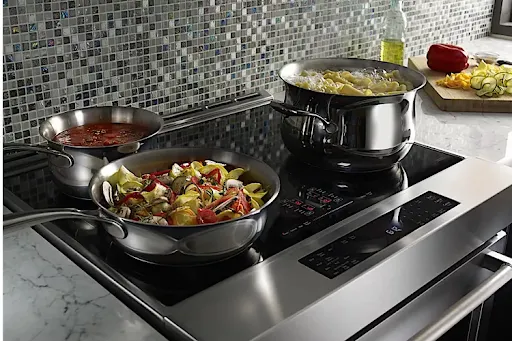
Photo courtesy of treehugger.com
If you’ve spent any time scrolling real estate listings lately, you may have noticed something subtle happening in kitchens.
It’s not just the cabinets or the counters.
It’s the cooktops.
Induction ranges — once dismissed as niche, expensive, or overly technical — are quietly becoming one of the most pleasant surprises for buyers once they actually use them. And like many upgrades, their appeal has less to do with specs and more to do with how they feel day-to-day.
For a long time, the kitchen conversation revolved around gas versus electric. Induction sat off to the side — misunderstood, rarely explained well, and often confused with standard glass-top electric ranges.
But that’s changing.
What induction actually is (and isn’t)
Induction doesn’t heat the surface the way traditional electric cooktops do. Instead, it uses electromagnetic energy to heat the pan itself. The cooktop stays relatively cool. The pan gets hot — fast.
That’s why people who try induction for the first time often have the same reaction:
“Oh… this is different.”
Water boils quicker. Temperature changes happen almost instantly. And once the pan is removed, the surface cools down far faster than gas or electric.
It feels more controlled. More precise. Less chaotic.
It’s like magic.
Why buyers end up liking it more than they expect
Induction wins people over for practical reasons, not novelty.
Speed: Faster than gas for boiling and searing
Control: Heat responds immediately when you adjust it
Safety: The surface doesn’t stay dangerously hot
Clean-up: Spills don’t bake onto the cooktop
Indoor air quality: No combustion, no gas byproducts
For families, especially those with young kids or aging parents, that safety piece matters more than they often admit upfront.
The big question homeowners always ask: “Will my pans work?”
This is the most common hesitation — and it’s a fair one.
Induction requires magnetic cookware. Cast iron works. Most stainless steel works. Aluminum and copper usually don’t unless they’re induction-ready.
Here’s the simple test:
If a magnet sticks to the bottom of the pan, it will work.
Many homeowners already own more compatible cookware than they realize. And for what doesn’t work, replacement doesn’t have to happen all at once. Most people transition gradually — replacing a pan or two as needed.
What about electrical upgrades?
This is where expectations need to be realistic.
Many induction ranges require a 240-volt connection, similar to an electric oven. Homes that already have electric ranges are often fine. Homes converting from gas may need an electrician to upgrade the circuit.
That cost varies by house — but in most cases, it’s manageable and predictable, not a mystery expense.
The key is planning.
Induction works best when it’s a deliberate upgrade, not a last-minute swap.
Is induction good for resale?
Short answer: yes — when it’s presented properly.
Buyers don’t always search for “induction” specifically. But once they see it — and especially once they experience it during a showing — it becomes a differentiator.
In higher-end homes, induction reads as modern and intentional.
In mid-range homes, it signals thoughtfulness and efficiency.
In condos and townhomes, induction avoids many of the gas and ventilation constraints that make kitchen upgrades difficult in shared buildings..
It’s no longer “weird.”
It’s quietly becoming smart.
The takeaway
Induction cooking isn’t about chasing a trend.
It’s about removing friction from everyday life.
Homeowners who make the switch rarely regret it.
Buyers who encounter it are often surprised — and then converted.
And in a market where small details increasingly shape buyer perception, induction is one of those upgrades that doesn’t shout… but it does stick.
References
U.S. Department of Energy. (2024). Induction Cooking Technology Overview. https://www.energy.gov
Consumer Reports. (2024). Why Induction Cooktops Outperform Gas and Electric. https://www.consumerreports.org
Harvard T.H. Chan School of Public Health. (2023). Gas Stoves and Indoor Air Quality. https://www.hsph.harvard.edu
Architectural Digest. (2024). Why Designers Are Switching to Induction. https://www.architecturaldigest.com