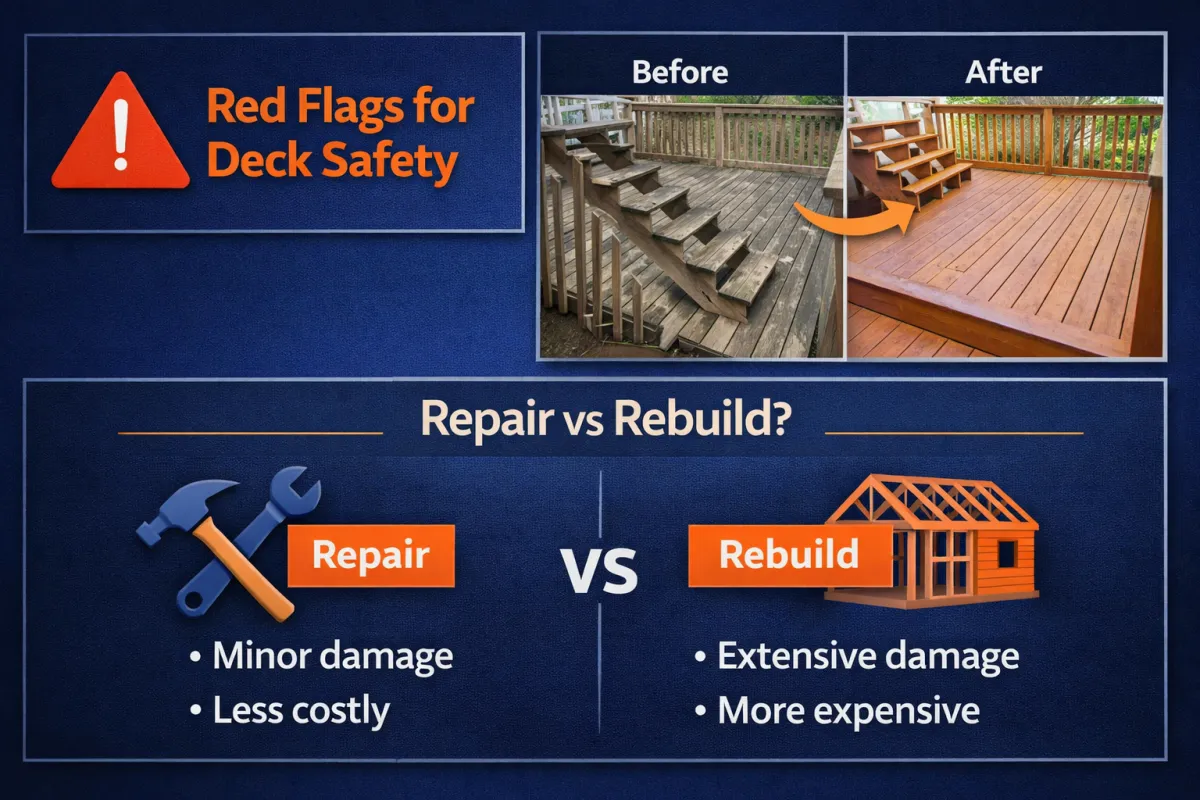
Deck Repair vs Rebuild Cost: What Homeowners Need to Know (2026)
The Problem With Decks Is That They Lie
A deck can look “basically fine” right up until someone who knows what they’re looking at steps on it, grabs the railing, or checks where it meets the house.
(or, as I’ve told clients, don’t walk on that deck because I won’t)
That’s the problem.
Decks are one of those parts of a home that homeowners tend to mentally file under outdoor wood stuff. If it’s still standing, it must be okay. If the boards aren’t collapsing, it probably just needs stain. If it wobbles a little... well... houses settle, right?
Honestly, many homeowners think a pressure treated deck doesn't need any maintenance. It’s totally natural for the deck boards and railings to cup or check, right?
Not exactly.
A bad deck is one of the easiest things for a buyer, inspector, or contractor to turn into leverage. Because unlike an ugly bathroom or outdated countertops, a questionable deck doesn’t just look old. It looks unsafe. And once the word unsafe enters the conversation, the price discussion changes fast.
What Usually Goes Wrong
Most deck problems are not dramatic at first. They’re subtle... until they’re expensive.
Sometimes it’s surface-level wear: cracked boards, popped nails, peeling paint, soft spots, loose railings, or stairs that feel like they’ve had a long week.
Other times, the real issue is structural. The ledger board may be poorly attached to the house. Flashing may be missing. Footings may be undersized or shifting (happens a lot). Posts may have rot at the base. Railings may be built to an older standard that no longer passes a serious look.
And sometimes the deck was just built by somebody with confidence, a pickup truck, and very little respect for gravity.
That’s when “small repair” turns into “why are we rebuilding half of this thing?”
Repair or Rebuild? That Depends on Where the Problem Lives
If the issues are mostly on the surface, repair is usually still on the table.
Replacing a handful of deck boards, tightening railings, repairing stairs, swapping out fasteners, or reinforcing a few areas may cost anywhere from a few hundred dollars to a few thousand, depending on labor, materials, and how much hidden damage shows up once the work starts.
If you’re dealing with isolated rot, a loose handrail, minor stair issues, or a few bad boards, you may be looking at roughly $500 to $3,500.
If the framing underneath is still solid but multiple components need work — boards, railings, stairs, some structural reinforcement — the number can move into the $3,500 to $8,000 range pretty quickly.
But if the structure itself is compromised, the conversation changes.
Once you have rot in load-bearing areas, failing footings, major movement, bad attachment to the house, or enough age and patchwork that nobody wants to stand behind it, rebuilding usually makes more sense than pretending you’re “repairing” it.
And yes, homeowners hate hearing that. Especially after already spending money on stain, paint, and cosmetic cleanup over the years.
What a Rebuild Really Costs
This is where people get surprised.
A modest deck rebuild is not a casual weekend-project number anymore.
For a basic pressure-treated deck, smaller and straightforward, you may still be in the $8,000 to $15,000 range.
A more typical full rebuild for a decent-sized deck — with stairs, railings, proper framing updates, and current-code details — can easily land in the $15,000 to $30,000+ range.
If you move into composite materials, larger footprints, multiple levels, custom rail systems, or tricky site conditions, the number can go well beyond that.
And that’s before you discover the old deck was attached badly, the framing near the house has water damage, or the stairs were apparently designed by somebody who considered measurements a form of oppression.
Why This Matters More Than Homeowners Think
A worn deck is not just a maintenance item. It’s a credibility issue.
When buyers walk a house and see a deck that feels soft, shaky, tilted, splintered, or overdue for divine intervention, they don’t think, “No big deal.” They think, “What else did these people ignore?”
That’s the real cost… and a real thing that really happens.
Even if the rest of the house is solid, a bad deck creates doubt. And doubt spreads. Suddenly the buyer is looking harder at windows, roof age, drainage, siding, and everything else they were willing to overlook five minutes earlier.
In a market where buyers are already more skeptical, a questionable deck can become an easy excuse to negotiate harder, ask for credits, or walk entirely.
What Should You Do This Spring?
If your deck is more than a few years old, this is a good season to stop guessing.
Walk it. Push on the railings. Look for soft wood, movement, rot, cracked boards, loose stairs, rusting hardware, and any place where wood meets the house or ground. If something feels off, don’t just stain over it and hope for the best.
Hope is not a repair strategy.
If the deck only needs targeted work, great — fix it now while it’s still a repair problem. If it’s structurally tired, patching it just delays the bigger bill and makes the conversation worse when it matters most.
A safe, solid deck adds enjoyment.
A sketchy one adds liability, negotiation leverage, and one more thing for buyers to judge you over.
And trust me... they will.