Before You Touch That Bathroom… Know Where the Money Actually Goes
Before You Touch That Bathroom... Know Where the Money Actually Goes
Why Bathroom Projects Go Sideways So Fast
Bathroom renovations fool people.
They look small.
They are not.
A bathroom is one of the easiest places in your house to light money on fire because everything is packed into a tight space: plumbing, electrical, tile, waterproofing, ventilation, trim, fixtures, and labor. One bad decision stacks on top of another fast.
That’s why the first question is not, “What color vanity should I buy?”
The first question is: What problem am I actually trying to solve?
Start With the Right Question
If you are thinking about updating a bathroom, work through this in order.
1. Are you updating for yourself... or to sell soon?
Those are not the same project.
If you are staying, the goal is function, comfort, durability, and not doing something you’ll hate in two years.
If you are selling soon, the goal is different. You are trying to improve buyer confidence without overspending on details the next owner may not value.
2. Is the problem cosmetic, functional, or structural?
This is where people get into trouble.
If the bathroom is ugly, that is cosmetic.
If it lacks storage, has bad lighting, poor ventilation, or a layout that annoys you every day, that is functional.
If there is water damage, soft flooring, mold, leaking plumbing, cracked tile from movement, or outdated wiring, that is structural.
Cosmetic problems can often be improved without blowing up the room.
Structural problems usually do not care about your budget.
3. Do you need a refresh, a remodel, or a rebuild?
A refresh might mean paint, mirror, lighting, hardware, faucet, vanity top, or accessories.
A remodel usually means replacing major visible components like the vanity, toilet, flooring, tile, or tub surround.
A rebuild means opening walls or floors, moving plumbing, fixing rot, correcting bad wiring, rebuilding a shower, or solving hidden problems.
If you misdiagnose which of those three you need, your budget gets smoked.
What Does It Cost?
There is no magic number, but there are realistic ranges.
A half-bath update may run roughly $3,500 to $10,000 depending on finishes, labor, and whether anything ugly is hiding behind the walls.
A full bathroom renovation often lands around $8,500 to $20,000+.
If you start moving plumbing, rebuilding showers, correcting old work, or uncovering water damage, the number can climb fast.
That is why “small room” does not mean “small budget.”
Where Homeowners Blow the Budget
Most bathroom mistakes are not dramatic.
They are boring.
And expensive.
People overspend on pretty finishes before solving the real problem.
They buy the trendy vanity and ignore the weak exhaust fan.
They obsess over tile patterns and forget that bad waterproofing can turn a nice bathroom into a mold experiment.
They pick fixtures that look expensive online but feel cheap in person.
They assume labor is simple because the room is small.
It isn’t.
A small bathroom gives you less room for error, not more.
The smaller the space, the more important proper planning is.
What the Good and Bad Examples Show
If you watch enough bathroom renovation videos, the pattern gets obvious.
The bad projects usually fail in one of three ways:
They chase looks before function.
They ignore hidden issues.
They spend like luxury buyers on a house that does not justify it.
The better projects are usually more disciplined. They improve lighting. They improve storage. They use cleaner materials. They avoid weird layout decisions.
And they match the level of finish to the house and the neighborhood.
A few useful examples:
You do not need to copy someone else’s bathroom.
You need to understand why one project works and another one goes off the rails.
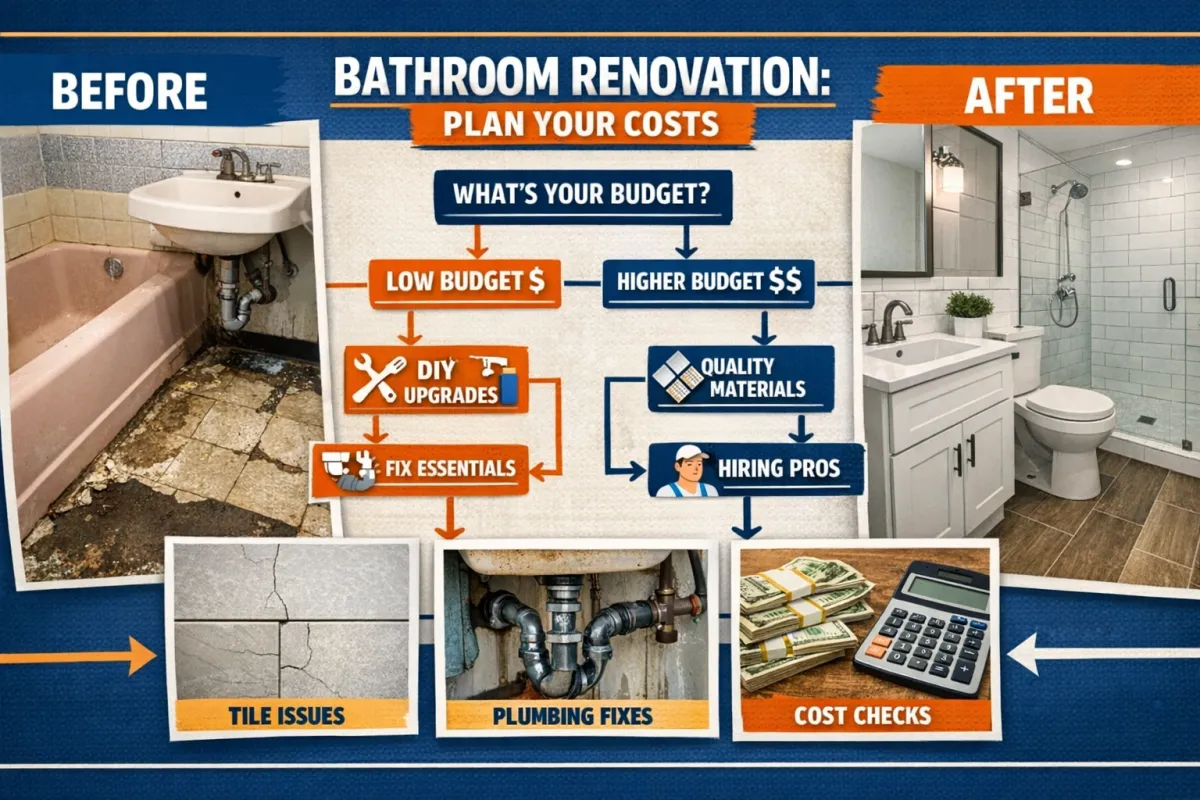
A Simple Decision Tree
If you want the short version, here it is.
If the bathroom is dated but functional, start with a refresh.
If the bathroom works poorly every day, look at a remodel.
If there is water, rot, mold, movement, or bad construction, stop pretending it is cosmetic and treat it like a rebuild.
And if you are selling soon, be very careful not to over-improve a bathroom for your price point.
That is one of the easiest ways to spend real money for a fake return.
Before You Spend a Dollar
If you are thinking about updating a bathroom, call me before you start buying materials.
Seriously.
I am not just a broker. I am also a licensed contractor.
That means I can help you think through whether you need a facelift, a smarter plan, or a full stop before the budget gets out of control.
Sometimes the best advice is “go ahead.”
Sometimes the best advice is “not like that.”
That conversation can save you a lot more than it costs.