The Appraisal Gap Is Back — and This Time It’s Sellers Who Feel It
Remember when “low appraisals” made buyers scramble for cash during the frenzy of 2021? That’s when real estate agents learned some new lingo like “appraisal gap coverage” and started negotiating that into a contract up-front. And if you’ve never heard of appraisal gap coverage, it’s essentially a blank check if not bound by a maximum out-of-pocket limit. More on that below.
I hated it. It was awful.
Fast-forward to 2025, and the gap is back—but this time, it’s sellers who are feeling it.
What’s happening
An “appraisal gap” occurs when a home’s appraised value comes in below the agreed-upon sale price.
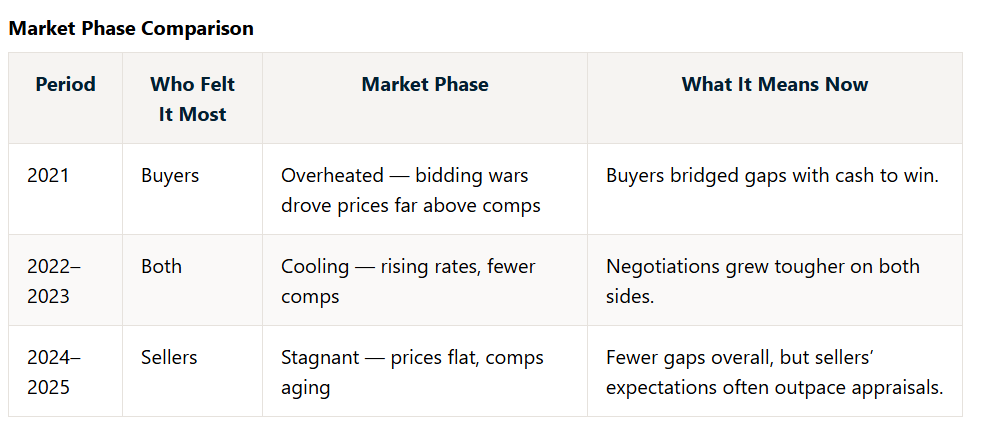
During the boom years, bidding wars pushed sale prices far beyond what comparable sales could support, so buyers had to make up the difference. In Boston it wasn’t uncommon for a home to go for $100,000 over asking price (or more)… with the buyer agreeing to cover any difference between the purchase price and the appraised value.
How did they justify it? Honestly, prices were escalating so quickly that they hoped another sale would close near the price they were going to pay prior to the appraisal and, quite often, that’s exactly what happened.
Today, the issue is reversed: in a slower, flatter market, sellers are often pricing their homes ahead of the data. Oftentimes, it’s against the advice of their agent. When those inflated expectations meet cautious appraisers, the results can be uncomfortable.
Nationally, the share of under-appraised homes has dropped from about 15 percent in 2021 to roughly 8 percent in late 2024.
Now, you may think like I did when I looked at this very quickly - hmmm… looks like low appraisals have reduced. That’s a good thing. And then I looked a little more closely.
The pain point has shifted.
In markets like Massachusetts and Rhode Island—where list-to-sale ratios have leveled off and time on market has crept upward—the “gap” now shows up as listings that must reduce price after a low appraisal, or worse, contracts that fall apart when the lender won’t match the agreed figure.
Why this matters
For sellers, a low appraisal can force a hard reality check.
Agents should:
Prepare realistic pricing strategies supported by recent, nearby comps—not spring’s record sales. When I’ve been pricing, I’m trying to keep to a 3-month look back window as opposed to a more common 6-month window. The market is too different.
Provide the appraiser with an organized upgrade and improvement sheet. If you want that top price, this is a must. This is no time to be shy.
Set expectations upfront: “If the appraisal comes in $15,000 low, here’s how we’ll handle it.”
For buyers, the math still matters: lenders base loans on the appraised value, not the offer. Appraisal-gap clauses, when used strategically, can strengthen offers without leaving buyers exposed.
What to watch in MA & RI
The Federal Housing Finance Agency recently flagged that many appraisers under-utilize time adjustments—failing to account for changing prices when comps are a few months old. I take this into account on all my comparable evaluations… along with differences in square footage (and below grade space is treated differently from above grade space), finishes, and location in your specific municipality.
In counties like Worcester, Bristol, and Kent, that can mean older sales from mid-summer don’t fully reflect fall’s softer conditions.
Since MLSPIN and Statewide MLS don’t publish appraisal statistics, agents can watch for proxy indicators: a widening spread between list-to-sale ratios and rising contract fall-throughs often signals low appraisals are back in play.
Call to action
As fall listings hit the market, it’s worth asking every seller:
“If the appraisal doesn’t meet the offer, what’s our plan?”
Smart agents who tackle that question now will protect deals—and reputations—later.
Market Phase Comparison
References
Boston.com. (2024, April 11). Low appraisals in Boston’s real estate boom. Retrieved from https://www.boston.com/real-estate/spring-house-hunt/2024/04/11/low-appraisals-in-bostons-real-estate-boom/
Federal Housing Finance Agency. (2024). Uniform Appraisal Dataset Aggregate Statistics. Retrieved from https://www.fhfa.gov/data/uniform-appraisal-dataset-aggregate-statistics
HomeLight. (2024). How often do home appraisals come in low? Retrieved from https://www.homelight.com/blog/how-often-do-home-appraisals-come-in-low/
MortgageOrb. (2024, December 2). 57% of appraisals were higher than the sales price in second half of 2024. Retrieved from https://mortgageorb.com/css-57-percent-of-appraisals-were-higher-than-the-sales-price-in-second-half-of-2024
NerdWallet. (2024). Appraisal gap: What buyers need to know. Retrieved from https://www.nerdwallet.com/article/mortgages/appraisal-gap
Redfin. (2024). What is an appraisal gap and how does it work? Retrieved fromhttps://www.redfin.com/blog/what-is-an-appraisal-gap/